
How psychological ownership, cultural intelligence, and decision rights clarity shape intrapreneurial leadership
Last week, I stood in front of 100 leaders in Mumbai and asked them a simple question: “On a scale of 1-5, how often do your team members solve problems without asking you first?”
The room went quiet. Not because they didn’t know the answer – but because they did.
I was in Mumbai as part of a speaking tour across India, delivering a session called “From Employee to Intrapreneur: Cultivating Ownership Mindset at Scale.” Intrapreneurship – the practice of applying entrepreneurial thinking within an existing organisation – is a concept most leaders say they want. But this particular session gave me something I wasn’t expecting: a deeper, more honest conversation about what intrapreneurship actually means when you strip away the Western corporate gloss.
What is psychological ownership – and why does it matter for intrapreneurship?
Psychological ownership is the state in which employees feel that their work, team, or organisation is “theirs” – even without legal ownership. It’s distinct from engagement or job satisfaction. According to research by Pierce, Kostova, and Dirks (2001), published in the Academy of Management Review, psychological ownership has three roots:
Efficacy – “Can I make a difference here?”
Identity – “Does this reflect who I am?”
Belonging – “Do I have a place here?”
When all three roots are present, employees take initiative, show pride in their work, and stay loyal. When even one is missing, you get compliance instead of commitment. You get people waiting for instructions rather than solving problems.
I used live polling throughout the session to make this tangible, and the results were striking.
Live data: what 100 leaders said about ownership in their teams
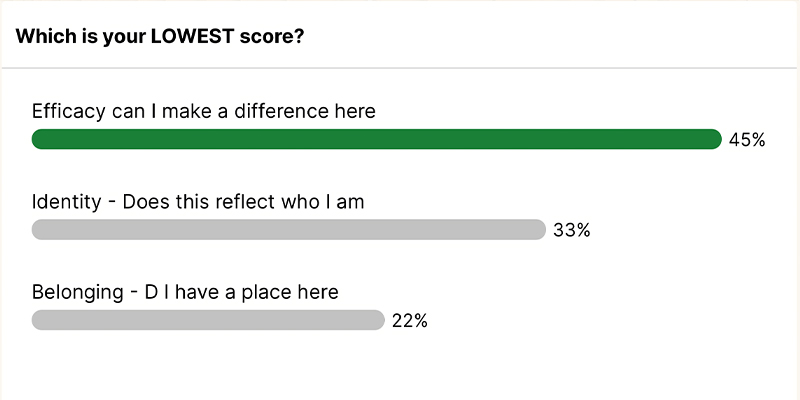
When I polled the audience using Slido, asking “Which is your LOWEST score?”, the results showed a clear pattern: 45% identified efficacy as their weakest root, followed by identity at 33% and belonging at 22%.
[Slido poll screenshot: “Which is your LOWEST score?” – Efficacy 45%, Identity 33%, Belonging 22%]
In other words, nearly half the leaders in the room said their teams’ biggest barrier to intrapreneurial behaviour was the fundamental belief that they can make a difference. Not a lack of belonging. Not a disconnect with the company’s identity. But efficacy – the conviction that their actions actually matter.
This finding aligns with global data. According to Gallup’s State of the Global Workplace 2025 report, only 21% of employees worldwide are engaged at work, and disengagement costs the global economy an estimated $438 billion in lost productivity annually. The people who escape that statistic are overwhelmingly those with a sense of psychological ownership over their contribution.
The difference between intrapreneurship and entrepreneurship: why it matters
This is where Mumbai gave me something special.
In many Western leadership sessions, the concept of intrapreneurship is met with enthusiasm. People nod along. They love the idea of acting like owners. But in Mumbai, someone asked the question that often goes unspoken elsewhere: “Why should I act like the owner? It’s not my business.”
It was direct. It was honest. And it was absolutely the right challenge.
Because here’s the crucial distinction – developing intrapreneurial qualities does not mean you need the capacity or desire to be a founder. Intrapreneurship is not about doing the owner’s job for the owner’s reward. It means developing qualities that serve you: the ability to spot opportunities, to take initiative, to solve problems creatively, to influence without authority. These are career-accelerating skills regardless of whether you ever start a business.
When we talk about intrapreneurship, we’re not asking people to sacrifice themselves for someone else’s profit margin. Research by Pierce et al. in the Review of General Psychology demonstrated that psychological ownership produces positive outcomes for the individual – including enhanced wellbeing, self-esteem, and identity – not just the organisation. The people who develop intrapreneurial qualities get promoted, get trusted with bigger projects, get more autonomy, and get more fulfilment from their work.
How culture shapes intrapreneurship: lessons from delivering leadership development in India
What made this Mumbai audience particularly rich to work with was the additional dimension of cultural context. In India, hierarchical structures often run deeper than in many Western organisations. Respect for seniority is woven into professional culture in ways that can make the “just take initiative” message feel naive – or even disrespectful.
So when I presented the Pierce model, I wasn’t just presenting a framework. I was inviting a room full of leaders to examine how cultural norms around hierarchy, deference, and authority interact with the conditions needed for psychological ownership. This is exactly why cultural intelligence – the capability to work and relate effectively across cultures – is so critical for any leadership development that aims to be genuinely global. If your organisational culture implicitly says “wait for permission,” then telling people to “think like owners” without addressing the systemic barriers is just empty motivation.
Live data: the one enabler leaders said would make the biggest difference
The second poll reinforced this. When asked “Which enabler would make the biggest difference?”, 31% of leaders chose “Decision Rights Clarity” – the single highest response, ahead of safe-to-fail experiments (19%), visible impact loops (19%), recognition that builds identity (19%), and protected time (13%).
[Slido poll screenshot: “Which enabler would make the biggest difference?” – Decision Rights Clarity 31%, Safe to Fail Experiments 19%, Visible Impact Loops 19%, Recognition that Builds Identity 19%, Protected Time 13%]

The audience wasn’t asking for inspirational speeches about ownership. They were asking for something far more practical: Tell me what decisions I’m actually allowed to make. When 45% say efficacy is the biggest gap, and 31% say decision rights clarity is the biggest enabler, the path forward is clear – and it starts with leaders, not employees.
Five enablers of intrapreneurship: what organisations that build ownership mindset actually do
Frameworks are one thing. What does intrapreneurship look like in practice? During the session, I shared examples of companies that have built intrapreneurial cultures – and importantly, they’re not Silicon Valley giants with unlimited innovation budgets. They’re organisations that understood five key enablers of intrapreneurship.
1. Decision rights clarity. Innocent Drinks built a culture where people are told: “70% confident? Just try it. No permission needed.” People know exactly how much authority they have.
2. Visible impact loops. Innocent also runs monthly company-wide finance meetings where everyone sees the numbers, so people can trace their work to real business outcomes.
3. Protected time. Redgate Software runs a “Down Tools Week” where everyone stops normal work to innovate – signalling that the organisation genuinely values intrapreneurial thinking.
4. Safe-to-fail experiments. Redgate’s philosophy includes an explicit “permission to fail and expectation of failure” – the kind of environment where efficacy can grow.
5. Recognition that builds identity. Innocent’s products carry the names of the people who created them, building the kind of recognition that strengthens people’s connection to their work.
These five enablers map directly onto the three roots of psychological ownership. They’re the practical mechanisms through which organisations move people along the ownership spectrum – from “that’s not my job” to “I’ve got this.”
What this means for leaders and L&D professionals
If you’re a leader trying to build intrapreneurial culture, or an L&D professional designing programmes to develop it, Mumbai reinforced three things for me.
Start with efficacy, not engagement. Before you worry about belonging programmes or identity initiatives, ask yourself: do my people genuinely believe they can make a difference? If not, no amount of team-building or values work will create ownership. Data from 100 leaders in Mumbai showed that 45% identified efficacy as their team’s weakest root – this is where the energy needs to go first.
Clarify decision rights before you demand initiative. The number one enabler this audience identified wasn’t more time, more recognition, or even psychological safety – it was clarity. People want to know the boundaries within which they can act. Without that clarity, “take ownership” is just a slogan. This finding echoes Gallup’s recommendation that managers need to coach and set clear expectations rather than simply demand discretionary effort.
Don’t confuse intrapreneurship with entrepreneurship. You’re not trying to turn employees into founders. You’re developing qualities – initiative, resourcefulness, creative problem-solving – that benefit both the individual and the organisation. Frame it that way, and you’ll get buy-in from people who would otherwise (quite rightly) ask “what’s in it for me?”
Why cultural intelligence matters in leadership development
If you’re designing intrapreneurship programmes for global audiences, the framework might be universal, but the conversation around it needs to be culturally intelligent. What works in a London boardroom won’t land the same way in Mumbai, and that’s not a problem – it’s an opportunity. The questions this audience asked didn’t weaken the framework. They made it stronger.
I’ve spoken to audiences across the world, and the energy of those 100 people in Mumbai was something special. The questions were sharp, the challenges were constructive, and the willingness to engage honestly with difficult ideas was remarkable. When people push back on your content in real time, that’s not resistance – that’s the sound of genuine learning happening.
Developing intrapreneurs isn’t about creating mini-CEOs. It’s about creating the conditions where people at every level feel they can make a difference, see themselves in the work, and know they belong. Get those three things right, and you won’t need to tell people to take ownership. They’ll do it because it serves them – not just the business.
Key takeaways
Psychological ownership is the feeling that your work is “yours,” and it has three roots: efficacy, identity, and belonging (Pierce et al., 2001). When all three are present, employees behave like intrapreneurs.
Efficacy is the biggest gap. In a live poll of 100 leaders in Mumbai, 45% identified efficacy as their team’s weakest area – people don’t believe they can make a difference.
Decision rights clarity is the number one enabler. 31% of leaders said knowing what decisions they’re allowed to make would have the most impact on intrapreneurial behaviour.
Intrapreneurship is not the same as entrepreneurship. Developing intrapreneurial qualities benefits the individual’s career – through promotions, autonomy, and fulfilment – not just the organisation’s bottom line.
Cultural context shapes how intrapreneurship shows up. Universal frameworks need culturally intelligent delivery to land effectively across different organisational and national cultures.
Frequently asked questions
What is intrapreneurship?
Intrapreneurship is the practice of applying entrepreneurial thinking – initiative, resourcefulness, creative problem-solving, and opportunity-spotting – within an existing organisation. Unlike entrepreneurship, it doesn’t require starting a new business. It means developing the qualities of a founder while working within someone else’s company. Research shows that intrapreneurial employees are more likely to be promoted, trusted with larger projects, and report higher job fulfilment.
What is psychological ownership in the workplace?
Psychological ownership is the cognitive-affective state in which employees feel that their work, team, or organisation is “theirs” – even without legal ownership. Research by Pierce, Kostova, and Dirks (2001, 2003) identified three roots: efficacy (believing you can make a difference), identity (seeing yourself reflected in the work), and belonging (feeling you have a place). When all three are present, employees show greater initiative, loyalty, and performance.
How do you develop intrapreneurial culture in an organisation?
Start by building the conditions for psychological ownership. Five key enablers support this: decision rights clarity (so people know what they’re empowered to do), visible impact loops (so people can see their contribution matters), protected time for innovation, safe-to-fail experiments, and recognition that builds identity rather than just rewarding output. Critically, frame intrapreneurship as something that benefits the individual’s career – not just the organisation’s goals.
What is the difference between intrapreneurship and entrepreneurship?
Entrepreneurship involves starting and running a new business. Intrapreneurship involves applying entrepreneurial qualities – initiative, creative problem-solving, opportunity-spotting, resourcefulness – within an existing organisation. Developing intrapreneurial qualities does not require the desire or capacity to become a founder. It means building skills that accelerate your career wherever you work.
Does intrapreneurship work differently across cultures?
Yes. Cultural norms around hierarchy, authority, and collective versus individual initiative all affect how intrapreneurial behaviour shows up. In cultures with deeper hierarchical structures, simply encouraging people to “take initiative” can feel naive or disrespectful without first addressing systemic barriers like unclear decision rights or punitive responses to failure. Leadership development programmes that aim to build intrapreneurial culture globally need cultural intelligence to adapt their delivery effectively.
Jenny Garrett OBE is the CEO and Founder of Jenny Garrett Global, a leadership development consultancy specialising in Inclusive Leadership, Entrepreneurial Leadership, and AI-Ready Leadership. She recently completed MIT’s AI Strategy and Leadership Programme and co-hosts the AI for Equity podcast. Jenny spoke across India in January-February 2026, delivering sessions in Delhi, Hyderabad, and Mumbai.
If this blog has you thinking about how cultural context shapes leadership development in your organisation, our Cultural Intelligence (CQ) programme– rooted in scholarly research and used by organisations including Harvard, Goldman Sachs, BMW, and Google – equips leaders to work and relate effectively across cultures. It’s one of the ways we help organisations move from universal frameworks to culturally intelligent practice. Get in touch to find out more.