
This one means a lot to us. After twenty years and more than fifty cohorts, our Tri-Level™ methodology has been named Professional Services Initiative of the Year at the 2026 British HR Awards. Selected from a record 474 entries, the recognition is for an approach that achieves 35%+ promotion rates by developing diverse talent, their line managers, and senior sponsors simultaneously. Dentsu was Highly Commended in the same category.
The award was presented on 22 April 2026 at the Grand Hall of the Grand Connaught Rooms in Covent Garden, London. But the real story is not one night. It is twenty years of refining what actually creates culture change in organisations rather than just training individuals in isolation.
What is the Tri-Level™ methodology?
The Tri-Level™ methodology is the proprietary framework that underpins every Jenny Garrett Global leadership programme. Over nearly twenty years of delivery across the NHS, financial services, energy, higher education, and the public sector, one insight has shaped everything we do: developing diverse talent in isolation does not create lasting change. The magic happens when you develop talent, their managers, and senior sponsors at the same time.
That is the essence of Tri-Level™. Three connected groups. One integrated development journey. Systemic change rather than isolated training.
- Level 1: The talent – intensive leadership development covering authentic leadership, influential communication, and strategic career progression.
- Level 2: The line managers – equipped through dedicated briefings, toolkits and ongoing support to unlock potential and become effective allies rather than unintentional barriers.
- Level 3: The senior sponsors – trained in active sponsorship and advocacy, not just mentoring, so they use their influence to open doors and remove structural obstacles.
The result is that when a cohort of eighteen talent participants goes through the programme, fifty-four people are actually in development. Participants grow. Their managers grow. Their sponsors grow. And the organisation around all of them shifts. You can read more about our approach on our Inclusive Leadership service page.
Why does developing talent alone not work?
Most leadership development programmes targeted at underrepresented groups focus entirely on the individuals themselves. Women’s leadership programmes develop women. Positive action programmes develop ethnically diverse talent. Early careers schemes develop new joiners. All worthwhile. All incomplete.
Here is what happens without the other two levels. A participant completes the programme energised, more skilled, more confident, and returns to an environment that has not changed at all. Her line manager still gives feedback on style rather than substance. Her senior leaders still endorse the programme publicly without actively sponsoring anyone. The structural barriers that made the programme necessary in the first place are still in place.
Talent-only interventions typically produce promotion rates of 10-15%. Tri-Level™ programmes consistently achieve 35% or higher. That is not a marginal difference. It is the difference between ticking a box and changing a trajectory.
What evidence is there that Tri-Level™ works?
Two recent case studies show the methodology in practice. Further case studies are available on our case studies hub.
Guy’s and St Thomas’ NHS Foundation Trust – the Excel programme:
At the end of year one of the Excel positive action programme at Guy’s and St Thomas’ NHS Foundation Trust, delivered across eight months to eighteen talented professionals from global majority backgrounds:
- 100% of participants would recommend the programme
- 95% felt they could be their authentic selves at work (up from 21% at the start)
- 100% felt confident talking to their line manager about race and ethnicity (up from 57% at the start)
- 89% felt confident discussing career aspirations with managers
- Participants secured promotions during and after the programme
One participant, Priya Gadar, Service Manager in the Patient Access Team, described the cross-cohort sense-making as transformative. Sitting in a room with colleagues from global majority backgrounds, recognising that experiences she had considered ‘normal’ were in fact responses to structural inequities, changed how she understood her own career.
Year two of the programme launches in 2026.
Ascend – women’s leadership in energy, finance, and higher education:
Ascend is our flagship women’s leadership programme, currently running with a major UK energy organisation and previously delivered in financial services and higher education. At the midway point in the current cohort, 100% of participants reported the programme is already having tangible impact on how they lead, communicate, and show up. 100% rated their senior sponsor support as extremely helpful – evidence that Level 3 of the Tri-Level™ approach is doing what it is designed to do.
The programme’s central idea is summarised in a single line: it is not about changing the woman, it is about setting the stage so she can be her best.
Why does this matter now?
In March 2026, the UK government confirmed it will introduce mandatory ethnicity and disability pay gap reporting for employers with 250 or more employees. The framework will mirror gender pay gap reporting, and crucially, action plans addressing any identified pay gaps will be mandatory alongside the numbers themselves.
Most ethnicity and disability pay gaps are driven by the same issue: underrepresentation at senior levels. Moving the headline numbers requires moving people through the pipeline, and moving people through the pipeline requires systemic change, not surface-level intervention.
This is where Tri-Level™ becomes more than a leadership development choice. It becomes a credible action plan. It is precisely the kind of sustained, measurable intervention that can evidence real progress when reporting begins. The employers who start now will be the ones with something meaningful to show when the first mandatory reports are due.
About the British HR Awards 2026
Now in its fifth year and powered by employee insight platform New Possible, the British HR Awards recognise outstanding initiatives across UK human resources. The 2026 edition received a record 474 entries from organisations ranging from start-ups to global enterprises, not-for-profits and public sector bodies.
The Professional Services Initiative of the Year category honours external consultancies whose work produces measurable organisational impact. The 2026 judging panel brought together Chief People Officers and HR Directors from organisations including NatWest Cushon, The AA, TalkTalk, The Open University, Shelter, SUEZ, PUMA UKI, BFI, Frontier Economics, and Cell and Gene Therapy Catapult.
The ceremony, hosted by comedian Lucy Porter, also featured a panel discussion titled Navigating ‘The Jagged Frontier’ (AI as fabric, not feature). A theme that resonates directly with the work we are doing through our AI-Ready Leadership practice.
Who is Jenny Garrett Global?
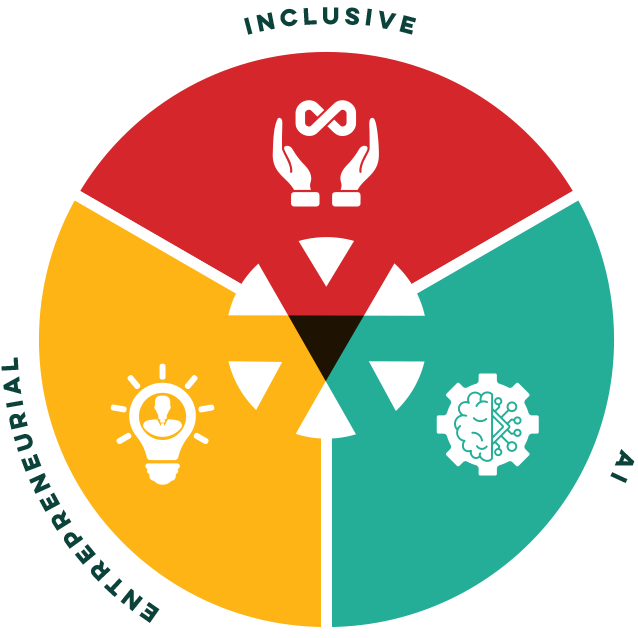
We are a UK-based leadership development consultancy founded in 2006 by Jenny Garrett OBE. The firm trades as Reflexion Associates Limited and our work spans three interconnected practice areas: Inclusive Leadership, Entrepreneurial Leadership, and AI-Ready Leadership.
Jenny received her OBE in 2021 for services to Entrepreneurship and Women in Business. She is the author of Rocking Your Role and Equality vs Equity, co-host of the AI for Equity podcast with her daughter Leah-Sunshine Garrett, and co-author of the forthcoming AI for Equity book (Emerald Publishing, October 2026). She is a Freeman of both the Worshipful Company of Entrepreneurs and the Worshipful Company of HR Professionals.
We deliver leadership development that is co-created with each client rather than pulled off the shelf. That reflects the depth of partnership Tri-Level™ delivery requires, and it is part of why the work lasts. You can see more about our impact here.
What sectors does Tri-Level™ work in?
The methodology has been delivered at scale across:
- Healthcare and NHS – positive action programmes, leadership development for global majority talent
- Energy and infrastructure – women’s leadership, inclusive leadership at scale
- Financial services and regulated industries – leadership pipelines, allyship programmes
- Public sector and local authorities – breaking-through leadership, EDI strategy
- Charity and social impact – homelessness, youth, and community-focused organisations
The common factor is not sector but intent. Tri-Level™ works for organisations that recognise leadership development as a structural challenge rather than a training gap.
How is this different from standard inclusive leadership programmes?
Conventional inclusive leadership training typically addresses one audience at a time. Talent programmes develop participants. Manager training develops managers. Sponsor briefings develop sponsors. These are often sequenced separately, delivered by different providers, measured against different outcomes.
Tri-Level™ differs in three specific ways:
- Simultaneous development at all three levels, not sequenced interventions that lose momentum between phases
- Shared language across the cohort, so talent, managers and sponsors can have genuinely aligned conversations about progression
- Accountability designed into the structure, with senior sponsors holding specific commitments rather than offering general endorsement
It is the integration that creates the results. Any one of these components in isolation is useful. Together, they are transformational.
What is next for Jenny Garrett Global?
The British HR Awards recognition sits within a wider programme of work in 2026. We will host our 20th anniversary at the House of Lords on 2 July 2026 – Built on Impact, 20 Years Forward – marking two decades of leadership development. The AI for Equity book, co-authored with Leah-Sunshine Garrett, will be published with Emerald Publishing in October 2026. And our AI-Ready Leadership practice continues to develop, recognising that the next generation of inclusive leaders will need to lead in increasingly AI-augmented workplaces.
If you would like to explore what Tri-Level™ might look like for your organisation, we would love to talk. Book a discovery call, or browse further case studies.
Frequently asked questions
What is the Tri-Level™ methodology?
The Tri-Level™ methodology is Jenny Garrett Global’s proprietary leadership development framework. It works simultaneously with three groups: diverse talent, their line managers, and senior sponsors. This integrated approach achieves 35%+ promotion rates, compared to 10-15% for talent-only interventions, because it addresses the systemic barriers to progression rather than placing the burden of change on individuals.
Why did Jenny Garrett Global win Professional Services Initiative of the Year?
Jenny Garrett Global won the 2026 British HR Awards Professional Services Initiative of the Year for the Tri-Level™ methodology, recognised for its measurable impact across two decades of delivery. The award was presented on 22 April 2026 at the Grand Connaught Rooms in London, selected from a record 474 entries across the awards. Dentsu was Highly Commended in the same category.
What results does the Tri-Level™ methodology produce?
Published outcomes include 35%+ promotion rates during or within 18 months of programme completion, 98% recommendation rates across programmes, and significant shifts in confidence, authenticity, and cross-cultural conversation. At Guy’s and St Thomas’ NHS Foundation Trust, the proportion of participants feeling they could be authentic at work rose from 21% to 95% during the eight-month programme.
How does Tri-Level™ support ethnicity pay gap action plans?
The UK’s forthcoming mandatory ethnicity and disability pay gap reporting regime will require large employers (250+ employees) not only to publish pay gap data but also to produce action plans addressing any gaps identified. Ethnicity pay gaps are driven largely by underrepresentation at senior levels. Tri-Level™ addresses this directly by developing diverse talent, their managers, and senior sponsors simultaneously, with measurable promotion outcomes of 35% or higher. It provides the kind of sustained, evidenced intervention that action plans need to be credible.
What is the difference between positive action and positive discrimination?
Positive action is legal under the UK Equality Act 2010 when there is evidence of underrepresentation. It provides additional development and support to address structural barriers. Positive discrimination – treating someone more favourably at the point of hiring or promotion because of a protected characteristic – is illegal. Tri-Level™ positive action programmes sit firmly within the legal framework while producing measurable progression outcomes.
How long does a Tri-Level™ programme run?
Tri-Level™ programmes typically run for six to twelve months. The Excel programme at Guy’s and St Thomas’ runs over eight months. The Ascend women’s leadership programme also runs over eight months. Shorter interventions rarely create the sustained culture change that Tri-Level™ is designed to deliver.
Who founded Jenny Garrett Global?
Jenny Garrett Global was founded in 2006 by Jenny Garrett OBE, an award-winning career coach and author of Rocking Your Role and Equality vs Equity. Jenny received her OBE in 2021 for services to Entrepreneurship and Women in Business. The firm trades as Reflexion Associates Limited and is headquartered in Hemel Hempstead, UK.