Ten questions on AI and equity, and the book I have just written with my daughter, Leah-Sunshine.
My new book, AI for Equity, is published on 27 October. In the run-up I have done a lot of interviews, and I have noticed that the same four or five questions come round every time. So I have written the ones I would rather answer. Do join us at one of our launch events
What is the question about AI you are most bored of being asked?
Is it going to take our jobs. Is it going to take over. Is it evil.
Those are reasonable fears and I am not going to tell anyone to drop them. But every one of them starts from fear, and fear makes you a spectator. You end up watching to see what AI does to you.
The better question is a different one. What is the biggest problem you see around you? Not the interesting problem. The one you have quietly given up on. The one that has been there so long you have stopped noticing it. Could AI help with that, and what part would you play in making it happen?
That question puts you back in the room.
Make the strongest case against your own book
That AI bakes inequity in at a scale we have never managed before, and makes it invisible while it does it. You cannot see where the data came from. You cannot see how it was processed. You cannot see what is being assumed about you.
And something is always being assumed about you. Given who builds these systems and what they are trained on, the default person in the machine is usually a white American man. If you are not that person, the answers you get are not quite calibrated for you, and nothing in the interface tells you so.
I test this myself. My AI knows I am a woman. When I ask it to respond to me as though I were a man, I get a different answer. Same question, different expectations, every stereotype about what each of us is supposed to want quietly doing its work in the background.
It is not only a chat window problem. The International Labour Organization found in March 2026 that 29% of female-dominated occupations are exposed to generative AI, against 16% of male-dominated ones. Among the workers facing the hardest transition, those with the least savings and the fewest transferable skills, 86% are women.
That is why explainability matters so much to me. Not as a technical nicety. As the difference between bias you can argue with and bias you cannot even find. Christian Ortiz built Justice AI to go at exactly this, and he is clear that the assumptions are in everything, not just in the obvious places.
So yes. That is the real risk. Inequity so deeply embedded that we stop being able to see it, and therefore stop being able to change it.
Which chapter changed your own mind?
Honestly, most of the mind-changing happened before the writing. We had already interviewed these people on the podcast, so by the time we sat down to write, the arguments had done their work.
The exception was chapter eight. Dr Keshav Malhotra works in fertility, and when he first started talking about AI in embryo selection my reaction was flat refusal. AI should not be anywhere near that decision.
What shifted me was context. Think about what sits around IVF in India. The stigma attached to not having children. The cost of treatment that puts it out of reach for most people. If AI makes IVF more affordable and more likely to work, then it stops being an abstract ethics question. It is someone having a child, and being spared a stigma they never deserved.
I still have the question I started with, just a better version of it. Where do the datasets come from? If a model is trained on patients in one country and used on patients in another, who is it actually accurate for? I no longer think AI has no business in that room. I think the question is whose bodies taught it.
Where did you and Leah disagree most?
Voice. Leah writes like an activist. I write like a coach. She takes a position and holds it. I acknowledge the other perspectives in the room and work with them.
Early on I thought we needed to sound like one person. A book should have one voice, shouldn’t it. I was wrong about that. Leah has her own perspective and her own generational experience of AI, which is not mine and never will be. Flattening that would have removed the most useful thing about the book.
So we kept both. Two generations, two ways of coming at the same problem, signposted on the page so you always know who is talking.
What do the people in this book have in common that has nothing to do with technology?
They are playful. That is the thing nobody expects. This is serious work about serious inequities, and the people doing it best are the ones experimenting, poking at things, treating AI as something to be curious about rather than something to be mastered.
They have also thought hard about what it means to be human. Not as a slogan, as actual work. Every one of them can tell you what they believe is irreducibly human about the problem they are trying to solve, and that is what tells them where AI belongs and where it does not.
As Dr Pauldy Otermans puts it, AI is not the solution. It is the tool. The solution is human.
What is the most boring, unglamorous thing AI does for you day to day?
I have a chief of staff. It is an email agent. It reads across my calendar and my messages and tells me what is coming, what I have not dealt with, and what deserves my attention this week rather than next. A second one preps me before meetings, so I walk in knowing what the last conversation was and what this one is for. I use an AI notetaker, which means I am in the room rather than writing in it.
None of that is visionary. It is admin.
But it is worth noticing who gets to do it. TrustedTech and Censuswide surveyed 2,001 UK and US employees in March 2026 and found 65% of senior decision-makers using unapproved AI tools at work, against 31% of employees below that level. PagerDuty’s shadow AI survey found 81% of employees believe leadership operates under different rules. We looked at both in our Trust Deficit white paper.
I have a chief of staff agent because nobody is going to stop me having one. That is not true for most of the people reading this.
Who do you most want to read this book?
The leader who thinks rolling out Copilot was the job. Licences issued, training done, everyone can summarise their emails now, next item on the agenda.
The gap is measurable. WalkMe’s State of Digital Adoption 2026, covering 3,750 people across 14 countries, found 88% of executives saying their people have adequate AI tools, and 21% of those people agreeing. That distance is the person I am writing for.
Beyond that, anyone who has quietly decided this is not for them. Including young people, who often have the sharpest objections. It took my graduate job. It is burning through water and power. Those losses are real and I am not going to argue anyone out of them. But there is more available than resignation. Frugal AI exists. Smaller models exist. The choice is not between accepting whatever gets built and opting out.
What did you cut that you still think about?
People, mostly. Erica Farmer does excellent work with HR leaders and I would have loved her in the book. Arti Samani works on deepfakes, with the sharpest examples I have come across, and that is a subject becoming more urgent by the month. Not least because the interesting part is the bit nobody says out loud. Deepfake technology is not only harmful. Some of it is genuinely useful, and holding both of those thoughts at the same time is difficult in a way that most of the coverage refuses to be.
Whole subjects went too. Disability deserves a book of its own rather than a section of ours, given how much of the earliest genuinely useful AI came out of accessibility work. The same goes for the environmental angle, and for sovereign AI, which is going to matter enormously and barely registers in equity conversations yet.
Fifty podcast episodes in, we could have kept going. The constraint was the book, not the material.
What will you be embarrassed about in five years?
That I did not push people harder.
We interviewed extraordinary people doing extraordinary things, and I was so interested in what they had built that I did not always ask the difficult question underneath it. Where did your data come from. Who did you leave out. What went wrong that you have not talked about publicly. The questions I now get asked, and that I have started asking of my own work.
Some of that is the coaching instinct. You create the conditions for someone to talk, and you protect the relationship. That is usually right. Occasionally it means you leave the sharpest thing in the room unsaid. It is the activist question, and Leah would have asked it.
The rest is fine. The book does not tell anyone how to use AI, there are prompts to copy, and coaching questions do not expire when the next model ships. But there is a version of this book where I was a harder interviewer, and it would have been a more useful one.
What do you actually want someone to take from it?
That we have choices.
Too often the framing is that AI has been unleashed and we simply have to keep up. You are not using AI, so you have been left behind. That is not an argument. It is a shove, and it is being used to sell a great deal of software to people who have not been given a moment to think.
We have been handed something extraordinary and we get to decide what it is for. The people in this book decided on purpose. They are not waiting for permission, and neither should you be.
Which brings me back to where I started. Stop asking what AI is going to do to you. Ask what you would fix if you could.
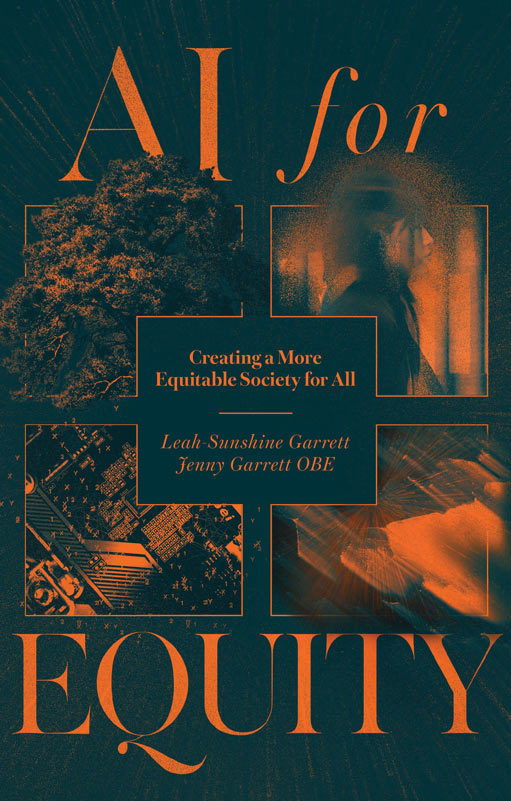
AI for Equity: Creating a More Equitable Society for All, by Jenny Garrett OBE and Leah-Sunshine Garrett, is published by Emerald on 27 October 2026. Pre-order here. Do join us at one of our launch events
Jenny Garrett OBE is Founder and CEO of Jenny Garrett Global, a leadership development consultancy specialising in Inclusive Leadership, Entrepreneurial Leadership and AI-Ready Leadership. She is co-author of AI for Equity (Emerald, October 2026), co-hosts the AI for Equity podcast, and is a graduate of MIT’s AI Strategy and Leadership Programme. JGG’s AI-Ready Leadership programmes work with organisations on equitable AI adoption, and its roundtable white papers on the two-tier workforce and the trust deficit are free to read.