
The Boardroom Myth: “Our Supplier Says It’s Fair”
Across the UK, many boards are approving the adoption of Artificial Intelligence (AI) tools- particularly in recruitment and talent management- under the comfortable, yet dangerous, assumption that these systems are neutral. The due diligence conversation often stops at a single point: “The supplier assured us their product is fair and compliant.”
As a leader in global talent and EDI consultancy, I am telling you this is not a defence. It is a fundamental leadership failure, and one that exposes your organisation to significant legal and financial liability under UK law.
Your supplier is not on the hook. Your board is.
The Alarming Evidence: Zero Selection Rates
The idea that AI is a neutral arbiter has been completely dismantled by recent research. Studies conducted in late 2024 and early 2025 simulating CV screening found that common large language models (LLMs) used in hiring systems demonstrated significant bias based on names and perceived gender and race:
* Racial Bias: In CV screening simulations, systems preferred white-associated names over 85% of the time.
* The Intersectional Crisis: Most alarmingly, research showed that when compared to white male candidates, CV’s associated with Black male candidates were selected 0% of the time in some occupations.
These are not fringe findings. They are verifiable, published data points that replicate decades-old patterns of bias, now automated and scaled up.
The fact that an algorithm can result in a zero percent selection rate for a specific protected group means AI is not merely reflecting bias – it is amplifying it and introducing a level of systemic exclusion that should terrify every board.
The UK Legal Reality: The Equality Act 2010
In the UK, your liability for AI bias is not based on the vendor’s intentions; it is based on the outcome under the Equality Act 2010.
The Act prohibits both direct and indirect discrimination based on nine protected characteristics, including race. (see Notes [1]).
When your organisation uses an AI hiring tool that systematically disadvantages a protected group, you cannot hide behind the algorithm.
* Indirect Discrimination: This is the most likely legal risk. If your AI system’s criteria (which might seem neutral, like “cultural fit” scores or specific keyword weighting) puts people who share a protected characteristic (e.g., race, age) at a particular disadvantage when compared to those who do not, you are unlawfully discriminating.
* The Proportionality Test: The only defence is to prove that the criteria is a proportionate means of achieving a legitimate aim. Given the availability of fairer systems and the fact that basic LLMs are proving to be so skewed, proving proportionality will be incredibly difficult – especially when the outcome is a zero-selection rate.
* Vendor Liability vs. Employer Liability: You are the one making the employment decision. The courts and the ICO are clear: the use of AI tools for “high-risk” decisions, such as hiring, firing, or performance assessment, still leaves the ultimate accountability with the employer. Saying, “The AI did it,” is not a shield.
The Board’s Fiduciary and Ethical Duty
This is not a purely technical issue for the IT team to handle. This is a question of risk, governance, and leadership – sitting squarely with the board.
The Mobley v. Workday collective action lawsuit in the US, which allowed a case to proceed against an AI vendor for alleged age, race, and disability bias in its system, has put the entire industry on notice. (see Notes [2])
While UK law is different, the principle of accountability remains: if you delegate a critical human decision to an algorithm, you assume the liability for its errors.
From my experience great leadership is about taking proactive responsibility. The failure to audit, test, and monitor your AI tools for bias is now a profound failure of governance and a breach of your ethical commitment to employees and candidates.
Immediate Action: A Question of Leadership
If your board has signed off on the use of AI in any process related to the Protected Characteristics under the Equality Act 2010, you must ask:
* Do we have documented evidence of the tool’s fairness metrics, independently verified against UK demographics?
* Do we know if the tool disadvantages any protected group, and if so, have we documented a proportionate and legitimate business aim for that disadvantage?
If you cannot answer these questions today, your organisation is operating under an extraordinary level of legal exposure. The time for blind trust in vendor statements is over. It’s time for a robust governance framework that puts people first.
Part 2 of this series will be released this week and will dismantle the myth of human oversight – revealing why relying on human review to catch algorithmic bias often makes the discrimination worse.
Notes / References
[1] UK Legal Framework: The analysis of direct and indirect discrimination liability concerning AI is based on the Equality Act 2010, which governs anti-discrimination law in the United Kingdom. Further guidance is provided by the Information Commissioner’s Office (ICO) and the Equality and Human Rights Commission (EHRC).
[2] AI Bias Research: The data on racial and intersectional bias (including the 85% preference for white-associated names and the 0% selection rate for Black male candidates in some simulated scenarios) is derived from academic research on the use of Large Language Models (LLMs) in resume screening, presented at major AI ethics conferences and widely reported by sources like the Brookings Institution and University of Washington research in late 2024/early 2025.
[3] Supplier Liability Precedent: The reference to the Mobley v. Workday lawsuit is a key case from the U.S. District Court for the Northern District of California (May 2025), which allowed a collective action to proceed against an AI vendor for alleged age, race, and disability discrimination in its automated screening tools. This case highlights the increasing global legal scrutiny on AI systems in employment.
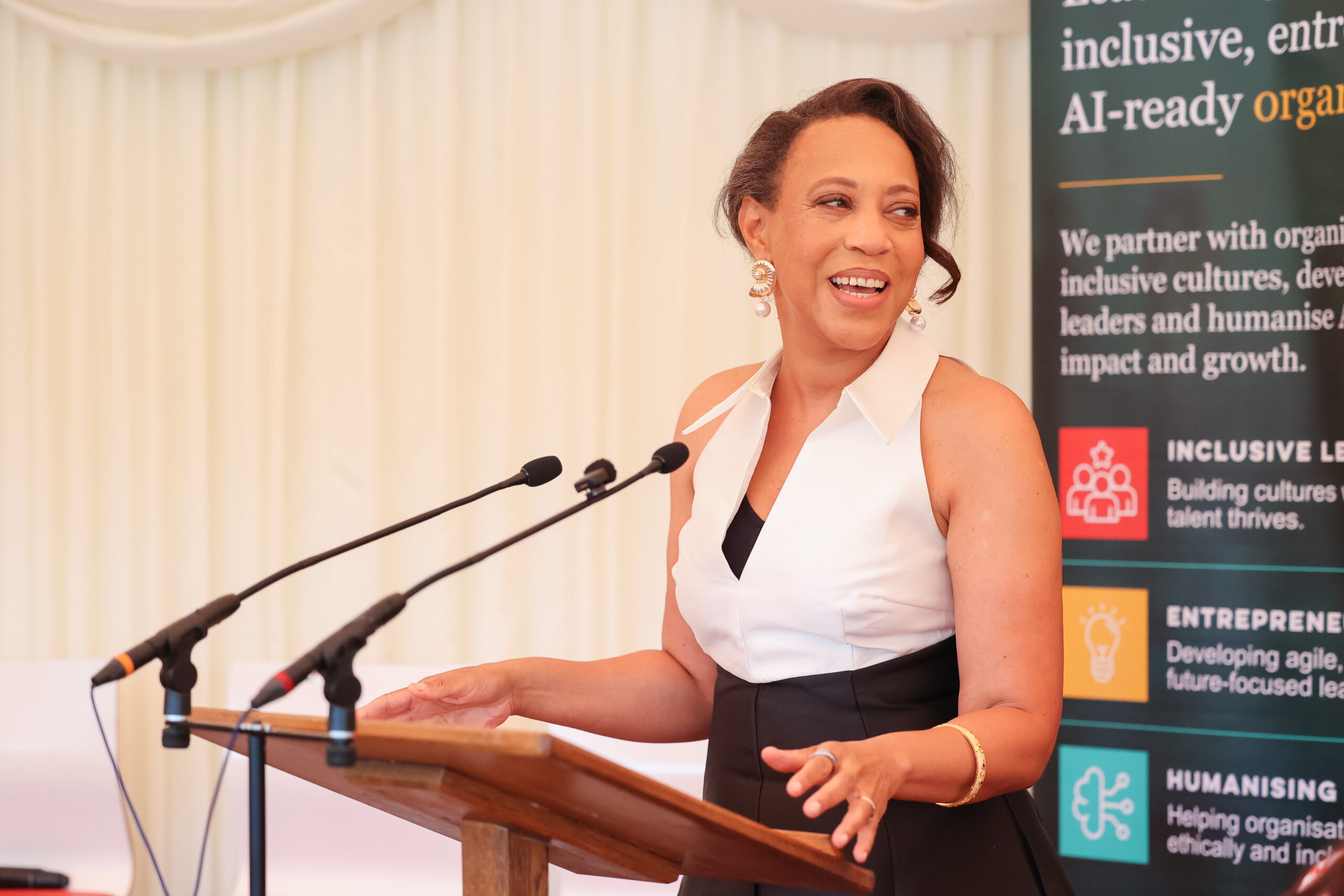
Jenny Garrett OBE is the CEO of Jenny Garrett Global, a highly successful and impactful global leadership, talent and EDI consultancy. She is the author of Equality vs Equity and Rocking Your Role. Her expertise lies in the strategic, human-centric application of leadership in an AI-driven world.
Jenny Garrett OBE

Jenny Garrett OBE is the CEO of Jenny Garrett Global, a highly successful and impactful global leadership, talent and EDI consultancy. She is the author of Equality vs Equity and Rocking Your Role. Her expertise lies in the strategic, human-centric application of leadership in an AI-driven world.