
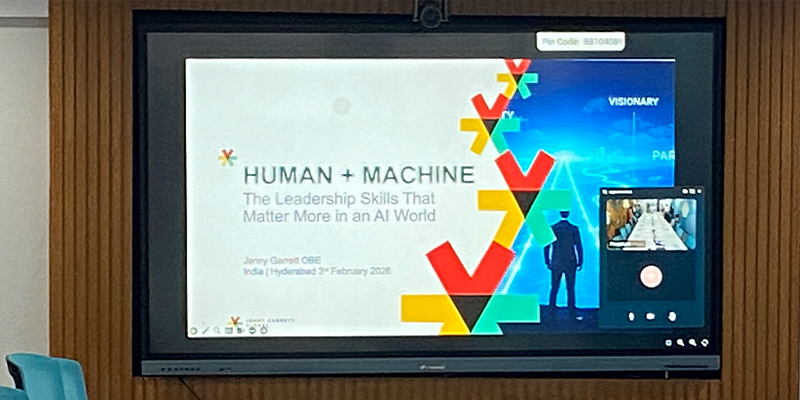
I’ve just returned from delivering a keynote to some of India’s fastest-growing business leaders as part of the Stanford Seed Network in Hyderabad, and I’m still processing the experience. The warmth. The generosity. The intellectual energy in that room. And the realisation that leaders on the other side of the world are grappling with exactly the same questions we are here in the UK. After all Hyderabad is a major, rapidly growing, IT and commerce hub.
The session was called “Human + Machine: The Leadership Skills That Matter More in an AI World” – and the title was deliberate. Not human versus machine. Human plus machine. Because the future isn’t about choosing one or the other. It’s about understanding what only we can do, and then using AI to amplify it.
But here’s what struck me most: many of the skills we discussed weren’t technical. They weren’t about prompt engineering or data literacy. They were deeply, distinctly human. And we’re at risk of forgetting them.
| 88% of organisations now use AI in at least one business function, yet fewer than 40% report measurable profit gains. Source: McKinsey Global Institute, “The State of AI in 2025” (November 2025) |
The gap between adoption and impact tells us something important: technology alone doesn’t deliver results. How we lead through it does.
The relational skills that retain your best people
One of the most energising conversations in Hyderabad centred on something remarkably simple: development conversations. The kind where a manager sits down with a team member and genuinely asks, “Where do you want to go? What’s getting in your way? How can I help?”
These conversations don’t scale through AI. They can’t be automated or templated. They require a leader who notices, who listens, who reads between the lines.
I shared a story from my own coaching practice. A client’s parent had recently died. We had a session scheduled. He told me he was fine to proceed. But he wasn’t fine. I could tell – from what he wasn’t saying, from the way he said it.
An AI would have taken him at his word: “Great, let’s proceed.” I didn’t. Because I’ve experienced loss. Because I understand nuance. Because I could read between the lines. That’s a human skill, and it’s the kind of skill that retains people. When your team members feel truly seen – not processed, not managed, but seen – they stay.
I also told the room about my experiment with an AI journaling app called Rosebud. For four weeks, it told me I was amazing. Week one: “You’re amazing.” Week two: “You’re amazing.” Week three: “You’re amazing.” Week four: “You’re amazing.” I thought, I would love to be that amazing. But I’m definitely not. AI mimics empathy. It doesn’t have it.
As Inkar, a guest on our AI for Equity podcast, discovered when she built Daisy, an AI mental health chatbot in Kazakhstan, people trusted the AI precisely because it couldn’t judge them. It created a safe space. But that’s fundamentally different from genuine human relating. There are moments when your people need non-judgmental space, where AI can genuinely help, and moments when they need someone who truly sees them, where only a human leader can go. Knowing the difference is the skill.
| The importance of people skills has grown 20% since 2018, even in roles previously considered primarily technical. Source: McKinsey Global Institute / World Economic Forum, “Agents, Robots, and Us” (2025) |
Don’t hand your strategy to AI
This was one of the most provocative points in the session, and it generated real debate. Too many leaders are starting to use AI for strategic thinking – asking it to generate business strategies, market analyses, competitive positioning. And the output looks impressive. It’s coherent, well-structured, and confident.
But here’s the fundamental problem: AI looks at the past and models the future from it. It’s drawing on what has already happened, what has already been written, what has already been tried. It’s pattern-matching on yesterday’s data to predict tomorrow.
Strategy, real strategy, requires something different. It requires imagination. It requires the courage to see a future that doesn’t yet exist and to bet on it. It requires understanding context that no dataset can capture – the culture of your organisation, the unspoken dynamics of your market, the gut feeling you have about where things are heading.
Julia Stamm, founder of She Shapes AI and a guest on our AI for Equity podcast, put it brilliantly: “We have agency here. It’s not something that happens to us. It’s something that we want to shape and have to shape.” That’s visioning. That’s strategy. And it’s irreplaceably human.
When I was at MIT studying AI Strategy and Leadership, one of the most powerful insights from Professor Deborah Ancona’s research was that the most effective leaders don’t try to compete with AI. They focus on four capabilities machines genuinely cannot replicate: sensemaking, relating, visioning, and inventing. Strategy sits squarely in the visioning space – and it belongs to humans.
| “Leadership is ultimately a uniquely human endeavour. AI may transform how we work, but only human leaders can determine why we work and what we’re trying to achieve.” Source: McKinsey, “Developing Human Leadership in the Age of AI” (January 2026) |

Innovation must be human
One of the most memorable moments in Hyderabad came during the discussion. A participant was thinking deeply about how AI could support India’s road infrastructure – a genuinely complex, high-stakes challenge involving geography, climate, policy, economics, and millions of people’s daily lives.
As we explored it together, what became clear was that AI could process the data, model the scenarios, and identify patterns. But the innovation, the creative leap that says “what if we approached this completely differently?”, that had to come from a human mind. A mind that understands what it feels like to travel those roads. A mind that can connect insights from completely unrelated fields. A mind that can imagine something that has never existed before.
Varun Bhanot, who appeared on our AI for Equity podcast, embodies this beautifully. He had no background in technology or fitness, yet he built one of the fastest-growing consumer companies in the UK by seeing a connection nobody else had seen. That’s inventing. And it doesn’t come from training data.
Idaja, another podcast guest, made a career pivot from cell biology to AI consultancy within eighteen months of first encountering ChatGPT. She followed what she described as “random opportunities that terrify you but light something up inside.” That instinct, that fire, is not something you can automate.
| 170 million new jobs will be created globally by 2030, while 92 million are displaced — a net gain of 78 million positions. The jobs growing fastest require distinctly human capabilities. Source: World Economic Forum, Future of Jobs Report 2025 |
What Hyderabad taught me
What moved me most about the Hyderabad session wasn’t the content I delivered. It was what came back. These were leaders of India’s fastest-growing businesses – ambitious, sharp, building something from nothing. And yet the questions they were wrestling with were the same ones I hear in London, in boardrooms, in conversations with CEOs across the UK.
How do I adopt AI without losing what makes us special? How do I develop my people when the technology is moving faster than any training programme can keep up with? How do I stay human in an increasingly automated world?
The answer, I believe, is not to resist AI. It’s to get clearer than ever about what makes us human. The development conversations. The strategic imagination. The creative leaps. The ability to sit with someone in their grief and know that “I’m fine” doesn’t mean fine.
These aren’t soft skills. They’re strategic assets. And in a world where AI can generate a report, draft an email, and analyse a dataset in seconds, they’re the skills that will define who leads and who gets left behind.
As Rod Brown, another of our podcast guests, observed: “You now have a 24/7 assistant at a PhD level to help you out. The question is how we as human beings take advantage of this new cognitive partner.” The answer is by being more human, not less.
What this means for your leadership
If you’re a leader navigating AI adoption, here’s what I’d invite you to consider.
When did you last have a genuine development conversation with someone on your team – not a performance review, but a real conversation about their growth, their fears, their ambitions?
Are you using AI to augment your strategic thinking, or are you quietly outsourcing it? There’s a critical difference between asking AI to help you explore scenarios and asking it to tell you what to do.
Where is innovation actually coming from in your organisation? Is it emerging from human insight, curiosity, and cross-pollination of ideas – or are you expecting algorithms to do the creative thinking for you?
The leaders who will thrive in this next chapter are the ones who understand that AI is a tool, not a replacement. That the human edge isn’t a nice to have, it’s the competitive advantage. And that the skills we’re most at risk of forgetting are precisely the ones we need most.
India reminded me of that. Hyderabad, with its warmth and its forward-thinking energy, reminded me that this isn’t just a UK conversation or a Western conversation. It’s a global one. And we’re all in it together.
Frequently Asked Questions
What are the human skills AI cannot replace?
Research from MIT identifies four leadership capabilities that AI cannot replicate: sensemaking (making meaning from chaos), relating (building genuine human connection), visioning (creating compelling futures), and inventing (developing novel solutions to unprecedented challenges). These require lived experience, emotional intelligence, and imagination that current AI systems do not possess.
Should leaders use AI for strategic planning?
AI can be a valuable tool for exploring scenarios and processing data, but strategic decision-making should remain human-led. AI models are trained on historical data and pattern-match from the past, which means they are inherently backward-looking. Strategy requires imagination, contextual understanding, and the courage to envision futures that do not yet exist — capabilities that are distinctly human.
How do development conversations help retain staff in an AI world?
As AI automates routine tasks, employees increasingly value being seen and supported as whole people. Genuine development conversations — where leaders listen, read between the lines, and help people grow — build the trust and connection that technology cannot replicate. Organisations that invest in these relational skills see higher retention and engagement.
What is AI-ready leadership?
AI-ready leadership is an approach to leadership development that prepares leaders and organisations to adopt AI effectively while keeping humans at the centre. It involves understanding which capabilities to delegate to AI, which to retain as distinctly human, and how to build cultures where people and technology work together. Jenny Garrett Global specialises in AI-ready leadership development for organisations at every stage of AI adoption.
What is the AI for Equity podcast?
The AI for Equity podcast, co-hosted by Jenny Garrett OBE and Leah-Sunshine Garrett, explores how AI can be developed and deployed equitably. Guests include technologists, entrepreneurs, and leaders from around the world who are working to ensure AI benefits everyone. The podcast informs a forthcoming book, AI for Equity: Creating a More Equitable Society for All (Emerald Publishing, October 2026).
References and Sources
1. Ancona, D. (2024). “The Four Capabilities Model.” MIT Sloan School of Management. Research on leadership capabilities in the AI era, part of MIT’s AI Strategy and Leadership Programme.
2. McKinsey Global Institute (2025). “The State of AI in 2025.” November 2025. Available at: mckinsey.com/capabilities/quantumblack/our-insights/the-state-of-ai
3. McKinsey Global Institute (2025). “Agents, Robots, and Us: Skill Partnerships in the Age of AI.” November 2025. Available at: mckinsey.com/mgi/our-research/agents-robots-and-us-skill-partnerships-in-the-age-of-ai
4. McKinsey (2026). “Developing Human Leadership in the Age of AI.” January 2026. Available at: mckinsey.com/capabilities/strategy-and-corporate-finance/our-insights/building-leaders-in-the-age-of-ai
5. McKinsey (2026). “Human Skills Will Matter More Than Ever in the Age of AI.” January 2026. Available at: mckinsey.com/mgi/media-center/human-skills-will-matter-more-than-ever-in-the-age-of-ai
6. World Economic Forum (2025). “Future of Jobs Report 2025.” Global analysis of labour market trends, skills demand, and the net impact of AI and automation on employment.
7. Stanford Seed (2026). Stanford Seed Transformation Network India. Programme supporting high-growth entrepreneurs across India. seed.stanford.edu
8. AI for Equity Podcast. Co-hosted by Jenny Garrett OBE and Leah-Sunshine Garrett. Available on Spotify, Apple Podcasts, and YouTube. Episodes referenced: Inkar (Daisy Mental Health AI), Julia Stamm (She Shapes AI), Varun Bhanot (Magic AI), Idaja (AI Consultancy), Rod Brown (Cognitive Partners).
About Jenny Garrett OBE
Jenny Garrett OBE is CEO and Founder of Jenny Garrett Global, a boutique leadership development consultancy with over 20 years’ experience specialising in AI-Ready Leadership, Inclusive Leadership, and Entrepreneurial Leadership. Jenny works with organisations including the NHS, UK Parliament, National Gas, and Lloyds Banking Group, using her signature Tri-Level™ methodology that works simultaneously with diverse talent, line managers, and senior sponsors. She holds an OBE for services to Entrepreneurship and Women in Business, recently completed MIT’s AI Strategy and Leadership Programme, and co-hosts the AI for Equity podcast with her daughter Leah-Sunshine Garrett. Jenny is co-authoring AI for Equity: Creating a More Equitable Society for All (Emerald Publishing, October 2026). She delivers keynotes, leadership programmes, and executive coaching globally.
To explore how Jenny can support your leadership development, visit our AI Leadership Services or get in touch.