
I said that out loud a few weeks ago, talking about AI adoption with Melvina Metochi, who serves on the Jenny Garrett Global advisory board, for their Leading Thought series.
I meant it as an instinct. It is something I have watched play out in rooms full of capable senior leaders who cannot understand why the tool they bought is sitting there gathering dust.
Then I went looking for the evidence. The instinct holds up. The picture is worse than I thought.
Two thirds of your people found out afterwards
SHRM surveyed 5,875 workers in March and April this year for Navigating AI in the Workplace: 2026. Half said they had heard from senior leadership that AI was coming before it arrived.
Split that average by seniority and it falls apart. 74% of directors and above were told. 55% of managers. 33% of the people actually doing the work.
Trust follows almost the same line. 80% of directors say they trust senior leaders when the subject is AI. Managers, 65%. Individual contributors, 47%, with a further 38% saying they are not sure either way.
Sit with that for a moment. Being told is the cheapest form of inclusion available to any organisation. It costs nothing. And two thirds of the people doing the work did not get it.
The thing we keep calling resistance
30% of workers have knowingly broken their organisation’s AI rules. 46% say the policy prevents them experimenting with tools that would make their work better. Separately, WalkMe’s study of 3,750 people found 9% of workers trust AI for business-critical decisions, against 61% of executives.
Most leadership teams read those numbers as a change management problem and commission more training.
Try reading them differently. A tool arrives unannounced. It was chosen by people who never asked what your day involves. It comes wrapped in a policy drafted by someone who has never done your job. Is scepticism really a deficit in those circumstances, or is it judgement?
The people quietly working around the rules are rarely the disengaged ones. Usually they are the ones trying hardest to get the work done.
I know the objection, because I have made it myself in client rooms. You cannot consult five thousand people before you have decided anything. That is fair. But consultation is not what is missing here. Communication is. Getting from 33% to 90% is not a difficult problem. It is an unglamorous one, and it does not come with a launch event.
The part that troubles me most
Directors report saving nine hours a week through AI. Individual contributors save four. Directors say 63% of their work now involves AI assistance. For individual contributors it is 34%.
So the group who knew first, trust it most and use it most is also banking most of the return. Every quarter this continues, the distance widens. A two tier workforce is forming in real time, and the line is not drawn by technical ability. It is drawn by who was in the room.
One further detail, which I find genuinely uncomfortable: those same senior leaders are the most likely to say their own AI output is low quality. Confidence is running ahead of competence at the top, while caution is being penalised at the bottom. We have this precisely the wrong way round.
A better set of questions
Licences issued and prompts run tell you about distribution, not adoption. If you are putting together a board pack, try these instead.
- What proportion of your people heard about AI from their own manager, before it turned up in their workflow?
- Where does trust in leadership sit by level, rather than in aggregate?
- What are people using that you have not approved, and what does that tell you about what you bought?
The organisations that get real value from AI over the next two years will not be the ones with the biggest budget or the cleverest model. They will be the ones where the person doing the work found out at the same time as the person signing the contract.
Adoption follows trust. Trust follows being told. And being told is free.
The full conversation with Melvina Metochi is on YouTube: Leading Thought. We also cover what twenty years has taught me about running a business on your own terms, which I wrote up separately in 20 Years, 21 Lessons.
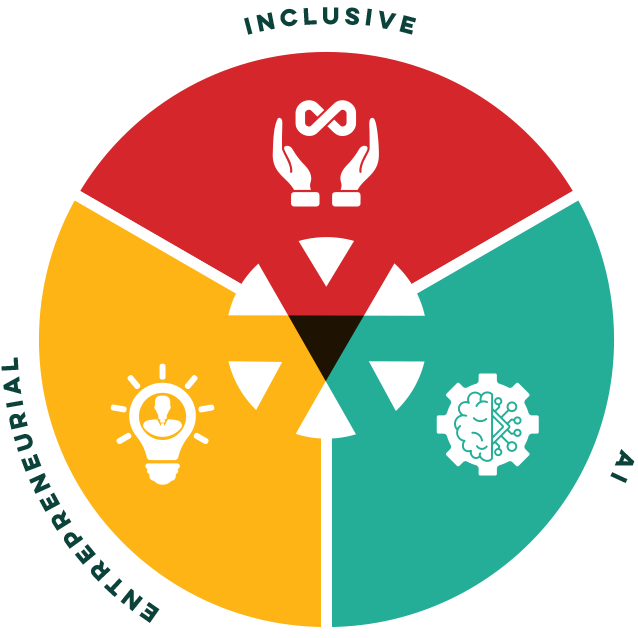
Jenny Garrett OBE is founder and CEO of Jenny Garrett Global, a leadership development consultancy working across inclusive leadership, entrepreneurial leadership and AI-ready leadership. Jenny is co-author of AI for Equity: Creating a More Equitable Society for All (Emerald, 27 October 2026) and creator of the EQUITAS framework for equitable AI adoption.
FAQ
Why do AI rollouts fail in large organisations? AI rollouts most often fail because of uneven communication, not poor technology. SHRM’s 2026 research found 74% of directors were informed before AI was implemented, compared with 33% of individual contributors. Trust in leadership tracks that same gap, and low trust suppresses adoption regardless of how good the tool is.
What is shadow AI and why do employees use it? Shadow AI is the use of AI tools an employer has not approved. SHRM found 30% of workers have knowingly broken their organisation’s AI policy, and 46% say existing policy prevents them experimenting with tools that would improve their work. Shadow AI is usually a signal that approved tools do not fit real workflows.
How should organisations measure AI adoption? Licence counts and prompt volumes measure distribution, not adoption. Better measures are the proportion of employees told about AI by their own manager before rollout, trust in leadership broken down by job level rather than reported in aggregate, and the gap between approved tools and the tools people actually use.