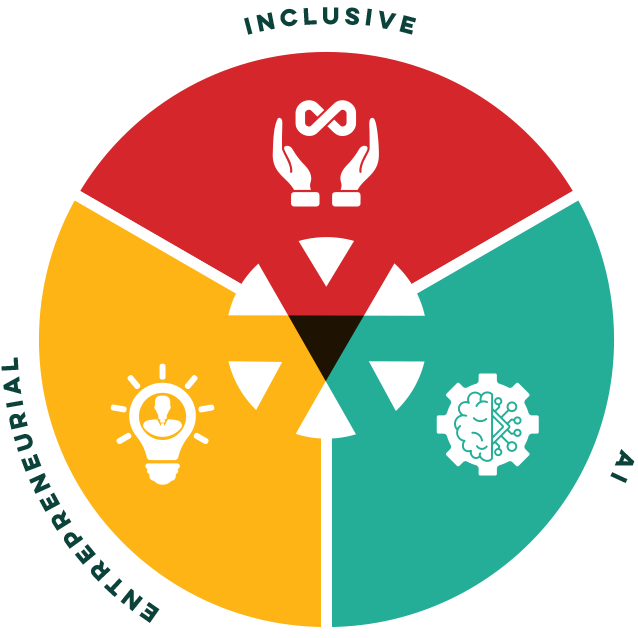

Leadership development expert Jenny Garrett OBE shares why purpose, inclusion and self-awareness are the keys to successful AI adoption – and what her time at MIT revealed about the trust gaps holding organisations back.
Something unexpected happened during my time at MIT’s AI Strategy and Leadership Programme. After twenty years in leadership development, I thought I’d seen every kind of organisational fear. But this was different. The bigger the company, the more afraid they were. Not of AI itself, but of what it was doing to their people.
Senior executives from global corporations sat in those sessions wrestling with the same question I hear from every client: how do we adopt this technology without losing the trust of everyone who works for us?
This is not a technology problem. This is a trust problem.
And that distinction matters enormously for how we think about leadership in the AI age.
The Trust Deficit AI Creates
The research paints a sobering picture. According to Pew Research Center’s 2025 survey, 52% of workers are worried about AI’s future impact in the workplace, with 32% believing it will reduce their job opportunities in the long run. Meanwhile, only 33% of consumers say they trust companies with the data they collect through AI technology, according to Attest’s 2025 Consumer Adoption of AI Report.
Perhaps most concerning: a Cornerstone OnDemand study found that while 80% of workers now use AI tools, only 44% have received any AI training, and just 16% receive it regularly. Among those encouraged to use AI, a third still lack training to support their usage.
Three trust gaps. Three relationships under strain: employees and employers, customers and businesses, leaders and their teams.

The Three Trust Gaps: AI adoption creates relationship strain at every level
Here is what the big consultancies will not tell you: you cannot solve a trust problem with better technology. You solve it with better leadership.
The Training Gap That Nobody Is Talking About
In all my years working with organisations, I have never seen such a disconnect between what they say they want and what they actually invest in.
McKinsey’s 2025 report found that nearly all companies are investing in AI, with 92% planning to increase investments over the next three years. Yet only 1% of leaders consider their organisations “mature” in AI deployment. According to IBM, there is an expected AI talent gap of 50% in 2024 alone.
The World Economic Forum reports that 77% of employers plan to reskill employees for AI collaboration between 2025 and 2030. But a ProfileTree analysis found only 38% of companies currently offer AI-related training to their staff, despite 82% of business leaders acknowledging its importance.
The message is clear: organisations are investing in the technology but not in the people who need to use it. And when people feel unsupported, they disengage. When they disengage, AI adoption fails.
What Empowered Leadership Actually Means
Empowered leadership is not a soft concept. It is a strategic response to the fundamental challenge AI creates.
When I work with organisations adopting AI, I see two approaches. The first treats AI as a tool for efficiency – automate processes, reduce headcount, optimise operations. The second treats AI as a tool for empowerment – enhance human capability, free people for higher-value work, build trust through transparency.
The first approach often fails. Not because the technology does not work, but because the people resist it. A Beautiful.AI survey found that 64% of managers believe their employees fear AI tools will make them less valuable at work, and 58% say employees fear AI will eventually cost them their jobs.
The second approach succeeds because it addresses the trust deficit directly.
Empowered leadership in the AI age rests on three principles:
Lead with why, not what
Most businesses start with the technology – what tools should we buy, what processes should we automate? Empowered leaders start with purpose. Not “what can AI do?” but “what do our people need? What do our customers deserve? What legacy are we building?”
Then – and only then – you ask how AI might help fulfil that purpose.
I call this purpose-led adoption. And it completely changes the conversation. When you lead with purpose, AI becomes a tool in service of human goals rather than a force that humans must adapt to.
Empower, do not automate
AI gives you a choice. You can use it to automate people out of decisions, or you can use it to help them make better decisions.
Automation says “the machine will decide.” Empowerment says “the machine will inform, and you will decide.”
This is not a small distinction. It is the difference between building a business that depends on technology and building a business that depends on people who are enhanced by technology.
At Jenny Garrett Global, we work with organisations using what we call the Tri-Level™ approach – developing not just individual contributors, but their managers and senior sponsors simultaneously. What we have found is that when people at every level feel empowered, adoption of any change — including AI — accelerates dramatically.
Protect your legacy
AI accelerates everything. If your business is built on exploitation, AI will help you exploit faster. If your business is built on service, AI will help you serve better.
The question is not just “should we adopt AI?” The question is “what kind of business do we want to build?” Empowered leadership considers not just quarterly results but generational impact.
The Advantage of Agility
Here is something that surprised me at MIT: the big corporations are terrified of small, agile businesses.
Large organisations have resources, but they also have complexity, bureaucracy, and legacy systems that slow down AI adoption. OECD data shows that while 40% of large firms (250+ employees) were using AI in 2024, only 11.9% of smaller firms (10-49 employees) had adopted it. But this is not because small businesses cannot adopt AI — it is because they have not yet recognised their advantage.
Smaller businesses can move faster, experiment more freely, and maintain the human relationships that become more valuable as AI commoditises routine tasks.
Your proximity to customers is a competitive advantage. Your ability to make decisions quickly is a competitive advantage. Your authentic relationships with employees and communities — these cannot be replicated by algorithms.
The most successful AI adopters will not be the companies with the biggest budgets. They will be the companies with the most empowered people.
Three Questions for Your Leadership
Before your next AI decision, ask:
Does this serve our purpose, or just our efficiency? If the answer is only efficiency, think again.
Does this empower our people to do more, or does it simply remove them from the process? When you empower rather than automate, you solve the first trust gap.
What would our stakeholders see if they looked at this decision in ten years? Imagine your grandchildren looking back at the choices you are making today. What do you want them to see?
Technology will keep evolving. The companies that thrive will be the ones led by people who understand that the human elements of business – trust, purpose, empowerment – become more important, not less, when machines can do everything else.
That is what empowered leadership means in the AI age. It is not optional. It is the only sustainable path forward.
Ready to humanise your AI adoption?
Our AI-Ready Leadership programmes help organisations build the trust, capability, and culture needed for successful AI transformation.
— • —
Jenny Garrett OBE is CEO and Founder of Jenny Garrett Global, a leadership development consultancy specialising in Inclusive, Entrepreneurial, and AI-Ready Leadership. She is a graduate of MIT’s AI Strategy and Leadership Programme and co-author of the forthcoming book “AI for Equity: Creating a More Equitable Society for All” (Emerald Publishing, October 2026). Listen to the AI for Equity podcast wherever you get your podcasts.
Research Sources Cited
1. Pew Research Center (February 2025) — “U.S. Workers Are More Worried Than Hopeful About Future AI Use in the Workplace” — Survey of 5,273 employed U.S. adults conducted October 2024. Found 52% worried about AI impact, 32% believe it will reduce job opportunities. https://www.pewresearch.org/social-trends/2025/02/25/u-s-workers-are-more-worried-than-hopeful-about-future-ai-use-in-the-workplace/
2. Attest (January 2025) — “2025 Consumer Adoption of AI Report” — Survey of 5,000 consumers in US, UK, Canada, Australia. Found 33% trust companies with AI-collected data (up from 29% in 2024). https://www.askattest.com/blog/articles/2025-consumer-adoption-of-ai-report
3. Cornerstone OnDemand (November 2025) — “Hidden AI” study surveyed 1,000 U.S. employees and 2,000 U.K. employees in October 2025. Found 80% use AI tools, but only 44% have received AI training, and just 16% receive it often. https://www.cornerstoneondemand.com/company/news-room/press-releases/hidden-ai-lack-of-training-keeps-ai-use-in-the-shadows-despite-ai-usage-encouragement-from-employers/ Also reported by HR Dive: https://www.hrdive.com/news/ai-use-secrecy-amid-lack-of-training/806312/
4. McKinsey (January 2025) — “Superagency in the Workplace” — Found 92% of companies planning to increase AI investments, but only 1% consider themselves “mature” in AI deployment. https://www.mckinsey.com/capabilities/tech-and-ai/our-insights/superagency-in-the-workplace-empowering-people-to-unlock-ais-full-potential-at-work
5. IBM (November 2025) — “AI Skills Gap” — Reports expected AI talent gap of 50% and notes companies lagging in AI training/upskilling. https://www.ibm.com/think/insights/ai-skills-gap
6. World Economic Forum / ProfileTree — WEF reports 77% of employers plan to reskill for AI (2025-2030); ProfileTree found only 38% currently offer AI training despite 82% acknowledging importance. https://azumo.com/artificial-intelligence/ai-insights/ai-in-workplace-statistics
7. Beautiful.AI (April 2025) — “AI’s Impact on the Workplace 2025” — Survey found 64% of managers believe employees fear AI will make them less valuable; 58% believe employees fear job loss. https://www.beautiful.ai/blog/2025-ai-workplace-impact-report
8. OECD (2024/2025) — “AI Adoption by Small and Medium-sized Enterprises” — Found 40% of large firms (250+) use AI vs 11.9% of small firms (10-49). https://www.oecd.org/content/dam/oecd/en/publications/reports/2025/12/ai-adoption-by-small-and-medium-sized-enterprises_9c48eae6/426399c1-en.pdf