Westminster Panel Addresses Critical Questions on AI’s Impact on Education and Professional Development
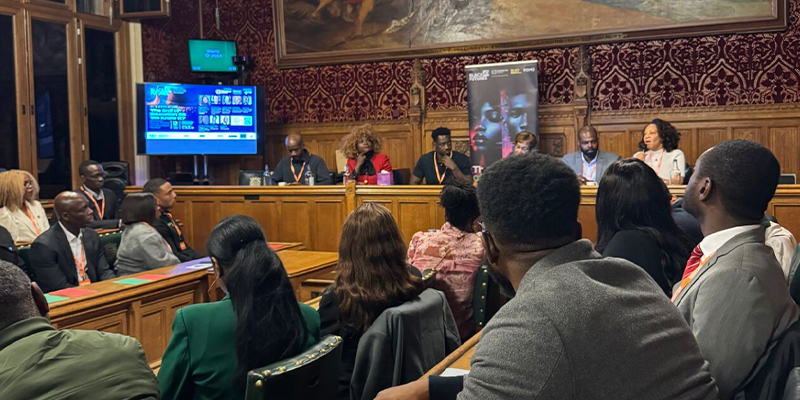
On 12th November 2025, UK Parliament’s Cromwell Hall hosted an AI and Education Panel event organised by Black AI Futures in collaboration with Future Ed. The event brought together 120 policymakers, educators, funders, tech leaders and students to examine how artificial intelligence is disrupting traditional education models and professional development pathways.
Expert Panel
The panel featured six leading voices:
- Dawn Butler MP – Vice Chair of the AI All-Party Parliamentary Group
- Bernadette Lewis – Secretary General of the Commonwealth Telecommunications Organisation
- Mark Martin – Founder of UKBlackTech & Professor at Northeastern University
- Yvonne Apiyo Braendle-Amolo – Swiss Parliamentarian & AI Activist
- Dino Myers-Lamptey – Founder of The Barber Shop & AI-First Marketing Educator
- Jenny Garrett OBE – CEO of Jenny Garrett Global & Co-host of AI for Equity Podcast
Key Themes: Critical Thinking as Our Firewall
Dawn Butler MP opened by emphasising that critical thinking must become our firewall as AI advances. She highlighted the climate impact of AI development, noting that generative AI’s massive resource consumption – particularly clean water – may ultimately limit its expansion. Butler stressed the importance of including climate considerations in any discussion of quantum computing and AI development.
Will AI Make Traditional Degrees Obsolete?
Mark Martin challenged assumptions about AI rendering degrees obsolete. Drawing a historical parallel to calculator bans in the 1960s, he argued that fundamental skills become more premium, not less valuable when new technology arrives.
Key points:
- Mathematics remains critical as the gateway to top AI and tech positions, regardless of AI capabilities
- Literacy, numeracy and public speaking will become premium skills of the future
- The 2014 UK curriculum shift from ICT to Computer Science caused significant student dropout, illustrating how sudden changes can disrupt educational pathways
- Experiences, not just classroom instruction, differentiate educational outcomes – students who visit museums, engage culturally, and access diverse opportunities develop differently
Martin emphasised: “We are the AI. If we depend on the machine for answers instead of using the collective intelligence in the room, we have a big problem.”
Data Sovereignty and Educational Access
Yvonne Apiyo Braendle-Amolo highlighted critical infrastructure questions around AI and education. In Switzerland, COVID-19 revealed that many students lacked computers at home, causing them to fall behind – illustrating how digital divides create AI divides.
Critical priorities:
- Data sovereignty: Communities need to control their own data rather than surrendering it to external data centres
- Building Africa-based data centres run on renewable energy that clean communities rather than pollute them
- Moving from mentorship to sponsorship in professional development
- Ensuring shared learning, open access and co-creation in AI education
Commonwealth Perspective: Building Local AI Capacity
Bernadette Lewis, representing 33 Commonwealth member states, outlined how existing education systems remain insufficient for the Fourth Industrial Revolution. She identified three immediate priorities:
- Curriculum Redesign – Integrating critical thinking and inclusive pathways
- Data Governance – Establishing national frameworks for data storage, access, and public interest use to prevent algorithmic manipulation
- Local AI Capacity – Funding skills development, research, and institutional capacity rather than depending on external AI infrastructure
Lewis emphasised fundamental questions: Who is creating our data? Who is writing our history? Where is this information being stored? Who is training the AI models that will influence policies and educational systems?
AI Coaching: Democratisation or New Gatekeeping?
Jenny Garrett OBE addressed AI’s disruption of professional development and workplace coaching, drawing on her 20 years of leadership development expertise. She used the 1990s grammar school tutoring transformation as a cautionary tale.
When grammar schools opened access through test preparation, it appeared everyone had a chance – but money remained a barrier. Wealthier families could afford tutors; others couldn’t compete. Similarly, while AI removes geographic, cost and scheduling barriers to coaching, social capital barriers persist.
Garrett warned: “We can all get degrees, but those who get the Russell Group degree potentially have more doors open to them. By giving us all AI doesn’t necessarily mean anything will change in the world. AI can give us intelligence and knowledge, but it still might not give us social capital.”
Beyond traditional systems:
Rather than simply democratising access to existing coaching structures, Garrett advocated for AI enabling communities to build entirely new infrastructure. Drawing on her experience founding the Diverse Executive Coach Directory and Rocking Ur Teens social enterprise, she demonstrated how new systems can be created – not just faster access to old ones.
Three conditions for AI coaching to genuinely level the playing field:
- Built with inclusive design from inception – Not existing elite pipelines scaled at speed
- Paired with community infrastructure – Leveraging collective power, not just individual advancement
- Used to challenge systems, not just adapt to them – Expanding definitions of success rather than performing traditional success metrics better
Garrett reframed the central question: “Are we building a better map to the same exclusive territory, or are we giving people the tools to claim new territory entirely? Continuous professional development isn’t about getting better at old rules – it’s about writing new ones.”
This perspective aligns with Jenny’s consultancy work on humanising AI adoption – ensuring that workplace AI transformation prioritises human elements like social capital, equity, and community infrastructure rather than purely technical efficiency. Her approach helps organisations implement AI in ways that expand opportunity rather than simply automating existing systems.
Explore Jenny’s work on humanising AI in the workplace →
Professional Development Amid Mass Layoffs
Dino Myers-Lamptey addressed workforce transformation, with Amazon (30,000), Microsoft (7,000), Salesforce (4,000), Intel (24,000) and Accenture (11,000) cutting positions as AI handles work previously done by junior employees.
Key insights:
The CBI predicts 8 out of 10 individuals will need to reskill by 2030. The future of work is increasingly fractional and transactional, with the critical skill being adaptability and resilience in continuous change.
While we exist in an information abundance era, “we’ve generated more data and information than ever before, but we’re arguably less intelligent, trusting machines and algorithms without thinking critically enough.”
Myers-Lamptey shared a military leadership framework: the most effective leaders are clever and lazy – they have intellectual clarity to identify real problems and make crucial decisions quickly. The dangerous combination: stupid and diligent.
The goal: train people to become more curious, culturally attuned strategists who use AI as a copilot for better, fairer ideas and decisions rather than seeking efficiency over value creation.
The Role of Supplementary Schools
Mark Martin highlighted how supplementary schools have been filling mainstream education gaps for decades, teaching what mainstream schools won’t and adapting faster than universities. Yet they’re overlooked in AI education policy conversations despite their agility and community-centred approach.
He shared a historical example: when Ignatius Sancho died, his family turned his grocery shop into a printing business – the “biggest AI” of the 17th century. This illustrates how communities have always been innovators, yet AI risks “polishing” and potentially erasing this history.
Why This Matters
The Parliamentary panel challenged dominant narratives about AI inevitability and efficiency by centring often-overlooked perspectives from Commonwealth nations, supplementary schools, and equity-focused practitioners.
Jenny Garrett’s emphasis on humanising AI adoption – prioritising social capital, community infrastructure, and system transformation over pure technological efficiency – offers a critical counterbalance to tech-first approaches. Her work demonstrates that successful AI transformation requires addressing human and equity dimensions, not just implementing tools.
Cross-cutting themes:
- Critical thinking is the essential skill for navigating AI-saturated environments
- Data sovereignty and ownership are prerequisites for equitable AI outcomes
- Community infrastructure and collective power matter more than individual AI access
- System transformation, not adaptation, should be the goal
- Supplementary schools are better positioned for agile AI adoption than traditional institutions
The event’s research contributions and policy recommendations position these voices as crucial in shaping how the UK approaches AI education, professional development, and equitable technology transformation.
Want to Explore These Questions with Your Team?
As Jenny asked at Parliament: “Are we building a better map to the same exclusive territory, or are we giving people the tools to claim new territory entirely?”
Jenny brings 20 years of leadership development expertise to conversations about AI transformation, helping organisations and leaders navigate change with clarity and purpose.
Available for:
- Keynote speaking at conferences and corporate events
- Executive workshops on AI and professional development
- Panel discussions and podcast interviews
🎙️ Hear more insights on the AI for Equity podcast →