Reflections from the European Women on Boards Event at The Shard By Jenny Garrett OBE
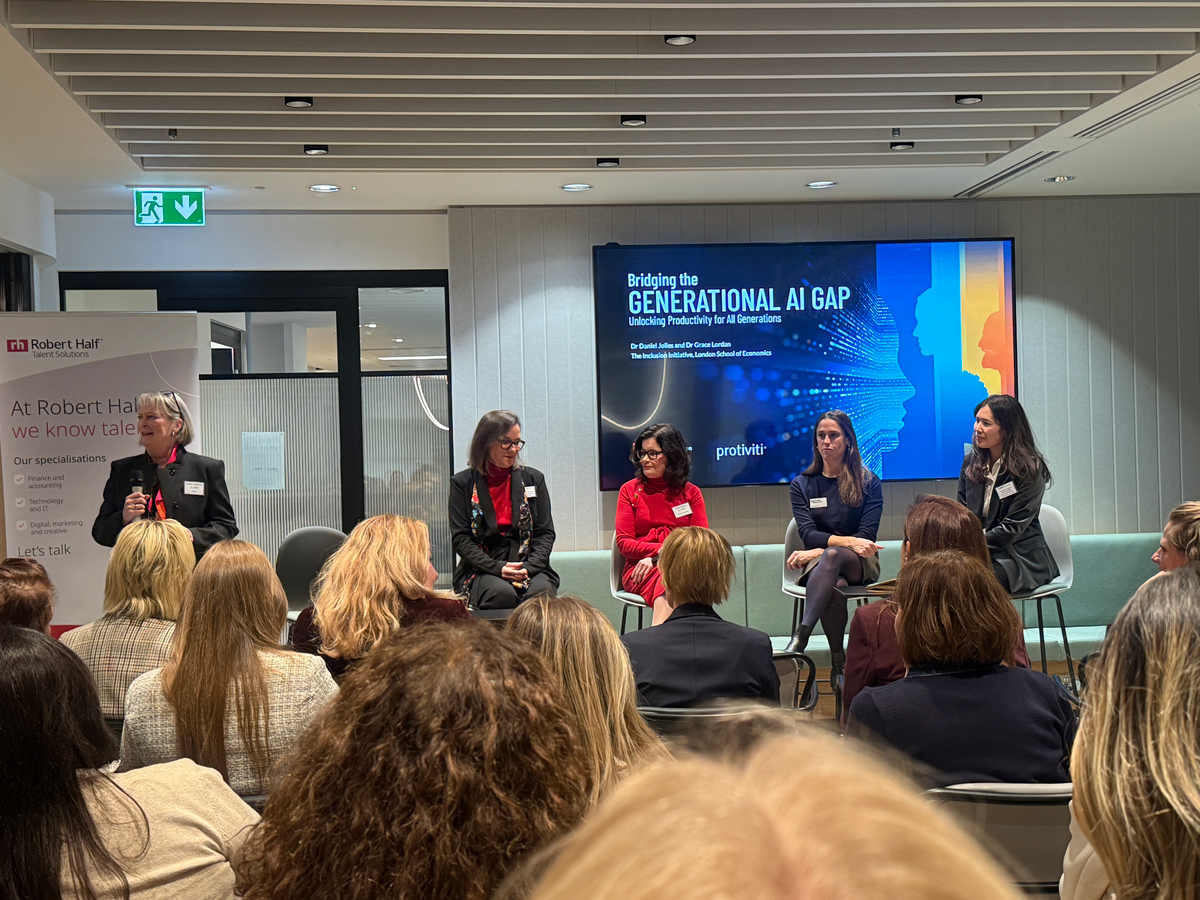
The generational AI gap is one of the most pressing challenges facing boards today. I attended the European Women on Boards panel discussion at Protiviti’s offices in The Shard, London, where leaders from across Europe gathered to discuss how different generations are shaping corporate purpose in the age of AI.
As someone who has been involved with the European women on boards from the beginning, I found myself reflecting on a question that troubles me: are we inadvertently positioning younger board members as “AI translators” – and if so, is that helping or harming our ability to govern AI responsibly?
What the Research Tells Us About the Generational AI Gap
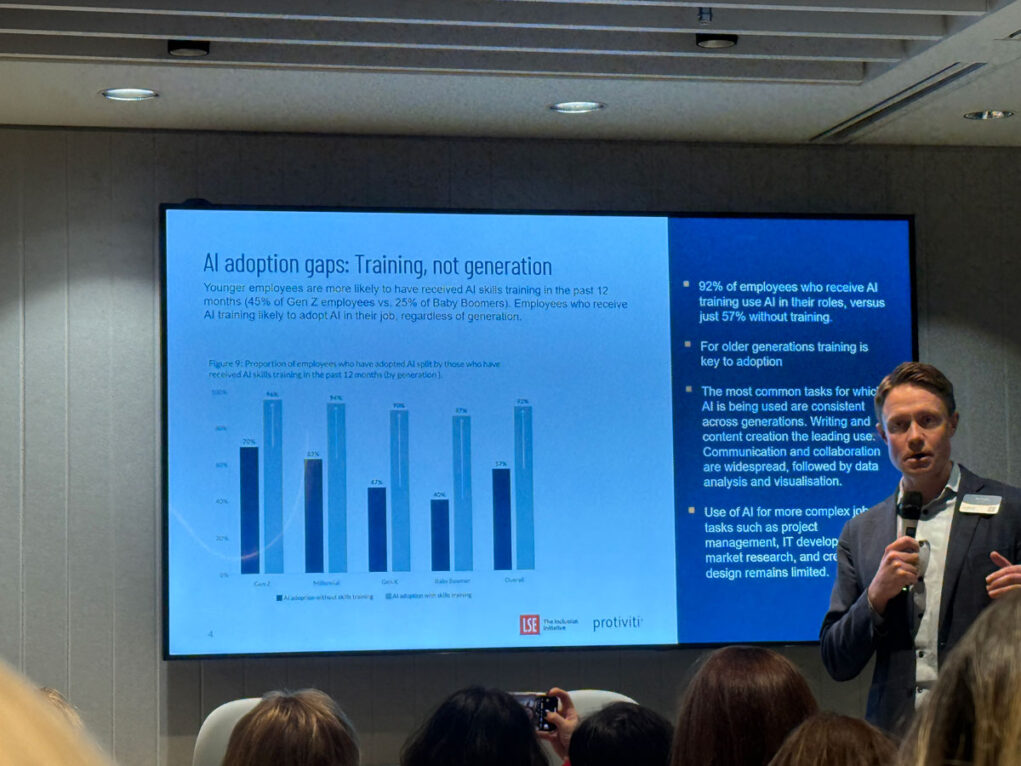
Research from The Inclusion Initiative at the London School of Economics, published in their 2025 Generations Survey, reveals the scale of the divide. While 82% of Gen Z employees use AI, only 52% of Baby Boomers do. This 30-percentage-point generational AI gap creates a natural, but potentially dangerous, dynamic in the boardroom.
It’s tempting to defer to those who appear most comfortable with the technology. But here’s what the research also shows: 51% of AI users do not trust AI-driven decisions. The generation most likely to use AI is not necessarily the generation best equipped to govern it.
This raises a critical question for boards: are we trusting a generation without adding the wisdom of experience?
Beyond Tokenistic Reverse Mentoring
During the panel discussion, leadership consultant Annett made a point that has stayed with me: don’t be tokenistic with reverse mentoring. Instead, truly embed a culture where every voice is valued and knowledge is shared within boards across generations. Take an individual approach, don’t put people in boxes.
This resonates deeply with how we approach AI-ready leadership at Jenny Garrett Global. The risk of the “AI translator” model is that it reduces complex governance questions to technical fluency. AI governance isn’t about knowing which buttons to press, it’s about understanding the ethical, strategic, and human implications of the decisions we’re making.
Why Intergenerational AI Teams Outperform
The LSE research offers a compelling case for bridging the generational AI gap through collaboration rather than delegation. Teams with high generational diversity report 77% higher productivity on AI initiatives, compared to 66% for low-diversity teams. The combination of digital fluency and institutional wisdom creates better outcomes than either alone.
Perhaps most striking: training is the single biggest driver of AI impact. Employees with AI training achieve 28% time savings, compared to just 14% for those without. This suggests the generational AI gap isn’t fundamentally about age, it’s about investment.

Questions Every Board Should Be Asking
As organisations navigate AI adoption, boards need to ask themselves some uncomfortable questions:
Who is leading AI conversations in your boardroom, and why them? Are you conflating digital fluency with governance capability? What assumptions are being made about who “gets” AI and who doesn’t? How are you creating space for experienced directors to ask fundamental questions without feeling diminished? And critically — are you investing in training that unlocks AI potential across all generations, or leaving people to figure it out alone?
Building AI-Ready Leadership Across Generations
At Jenny Garrett Global, our approach to AI-ready leadership development isn’t about technical expertise, it’s about developing the judgement, ethical grounding, and inclusive mindset to harness AI responsibly. That means bringing together the perspectives of every generation, not delegating to whichever cohort seems most comfortable with the technology.
The research is clear: when we invest in people across generations, we unlock productivity. When we create genuinely diverse teams, we make better decisions. The question isn’t whether younger or older generations should lead on AI, it’s how we create the conditions for true intergenerational exchange.
Because wisdom without fluency is limited. And fluency without wisdom is dangerous.
Ready to build AI-ready leadership in your organisation? Explore our AI-Ready Leadership programmes or get in touch to discuss how we can support your board.
Frequently Asked Questions
What is the generational AI gap?
The generational AI gap refers to significant differences in AI adoption, confidence, and usage across age groups in the workplace. According to research from the London School of Economics, 82% of Gen Z employees use AI compared to 52% of Baby Boomers. This creates challenges for organisations seeking to implement AI effectively and govern it responsibly across their workforce and leadership.
How can boards bridge the generational AI gap?
Boards can bridge the generational AI gap by investing in tailored AI training across all age groups, creating intergenerational teams for AI initiatives, fostering a culture where questions about AI are welcomed regardless of seniority, and importantly, separating technical fluency from governance capability when determining who leads AI oversight. Research shows that high-generational-diversity teams report 77% higher productivity on AI initiatives.
What is AI-ready leadership?
AI-ready leadership is a leadership approach that combines ethical judgement, inclusive decision-making, and strategic thinking with an understanding of AI’s capabilities and limitations. It’s not primarily about technical expertise, but about developing the mindset and skills to govern AI responsibly, harness its potential whilst managing its risks, and bring diverse perspectives — including intergenerational perspectives — into AI decision-making.
Why does generational diversity improve AI outcomes?
Research from the London School of Economics shows that high-generational-diversity teams report 77% higher productivity on AI initiatives compared to 66% for low-diversity teams. This is because intergenerational teams combine digital fluency (often stronger in younger employees) with institutional knowledge, strategic judgement, and risk awareness (often stronger in experienced employees), leading to more balanced and effective AI implementation.
How does AI training impact productivity across generations?
According to research by The Inclusion Initiative at LSE, employees with AI training achieve 28% time savings through AI use, compared to just 14% for employees without training. This makes skills training the single biggest driver of AI impact — and importantly, this benefit applies across all generations. The generational AI gap can be significantly reduced through targeted investment in training.
Should younger employees lead AI initiatives on boards?
Not necessarily. Whilst younger employees may have higher AI adoption rates, research shows that 51% of AI users do not trust AI-driven decisions. AI governance requires more than technical fluency — it demands strategic judgement, ethical reasoning, and institutional knowledge that often comes with experience. The most effective approach is intergenerational collaboration, where digital fluency and wisdom of experience combine to create better AI governance.