Foreword
People ask me one question more than any other right now: how do I stop AI taking my job? It is the right worry. I think it is the wrong question.
The evidence so far says AI rarely takes a whole job in one go. It takes tasks. It changes what employers hire for. And it quietly closes doors before people notice they were ever open. That last part concerns me most, because the doors closing first are often the ones under-represented talent uses to get in.
So this report asks a better question: how do you shape your role before AI shapes it for you? It draws on the most current UK and Western research available. Every figure links to its source, so you can check it, challenge it and use it.
Potential is everywhere, but opportunity is not. AI can widen that gap or help close it. Which one happens depends on the choices individuals and leaders make now.
Jenny Garrett OBE, Founder and CEO, Jenny Garrett Global

At a glance
AI is reshaping UK work faster than it is removing it, but the pressure is real, rising and unevenly shared.
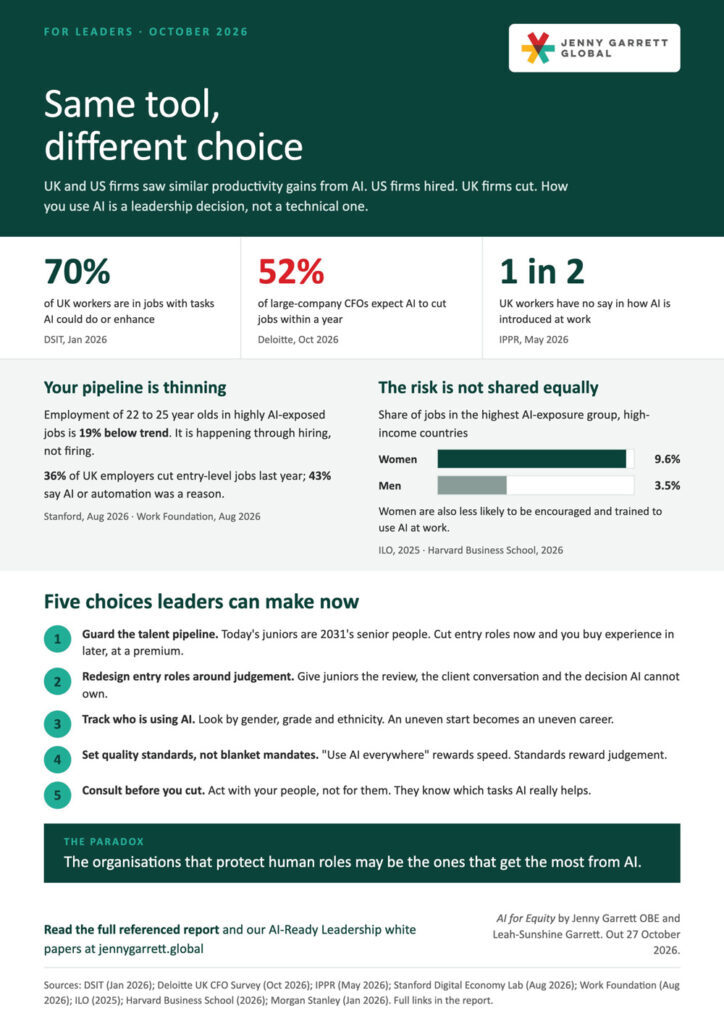
- Exposure is not replacement, yet. Around 70% of UK workers are in occupations with tasks AI could perform or enhance (DSIT, Jan 2026). Yet only 6% of AI-using UK firms report an AI-related cut in headcount (ONS via Resultsense, Oct 2026).
- The UK is cutting harder than its peers. UK firms using AI reported 8% net job losses, twice the international average (Morgan Stanley via Computing, Jan 2026). This month, 52% of large-company CFOs said they expect AI to cut headcount within a year (Deloitte via Bloomberg, Oct 2026).
- The squeeze is at the start of careers. 36% of UK employers cut entry-level jobs in the past year, and 43% say AI or automation reduced them (Work Foundation via Explainx, Aug 2026).
- The risk is not shared equally. In high-income countries, 9.6% of women’s jobs sit in the highest-exposure category, against 3.5% of men’s (ILO via The People Space, 2025).
- Human plus AI is what gets paid. The UK wage premium for AI skills reached 34.2% (PwC, 2026), while employers increasingly prize judgement, creativity and leadership alongside it.
What is really happening
The headline is not mass redundancy. It is a slow narrowing of the door in, and a steady rewrite of what each job contains.
Tasks first, jobs second
The UK government’s own assessment splits the workforce into three: 35% highly exposed with high complementarity (AI likely to help), 32% highly exposed with low complementarity (AI more likely to substitute), and 33% with low exposure (DSIT, Jan 2026). The International Labour Organization reaches a similar view globally: few jobs are fully automatable, and transformation is the most likely outcome (ILO, 2025).
Two stories at once
Official data and employer intentions point in different directions. Both matter.
| Signal | What it shows | Source |
| ONS business survey, Sep to Oct 2026 | 6% of AI-using firms report an AI-related fall in headcount; 38% say admin and clerical roles are most affected | Quasa |
| Announced UK job cuts, Jan 2025 to Oct 2026 | Employers tied 2,907 of 111,306 announced roles to AI or automation | British Resilience Index |
| Morgan Stanley, Jan 2026 | UK firms using AI report 8% net job losses, the highest of five economies; the US created more than it cut | Computing |
| CIPD Labour Market Outlook | 17% of employers expect AI to shrink their workforce within a year, with junior roles most at risk | CIPD |
| Deloitte CFO Survey, Oct 2026 | 52% of large-company CFOs expect AI to cut headcount within 12 months | Bloomberg |
| McKinsey State of AI, Aug 2026 | 32% of firms expected AI headcount cuts; a year later, 14% reported them | McKinsey |
Read together, intentions are running ahead of evidence. But intentions shape hiring plans, and hiring plans shape careers. Bloomberg Economics also cautions that vacancies in AI-exposed UK roles were already falling before ChatGPT arrived (Staffing Industry Analysts). AI is landing on a labour market that was already cooling.
The jobs that are never advertised
Here is the paradox: the biggest effect of AI so far is on jobs that do not exist yet. Stanford’s latest analysis finds young workers in highly AI-exposed occupations now sit 19% below where their employment would otherwise be, and the gap is opening through reduced hiring rather than layoffs (Stanford Digital Economy Lab, Aug 2026). You do not lose a job you were never offered, which is why this shift is so easy to miss.
What the latest headlines tell us
This month, HSBC was reported to be consulting on cuts affecting around 70% of UK wealth financial advisers as part of a wider AI push (Reuters via The Star, Oct 2026). The cautionary counter-example is Klarna, which reversed an AI-driven freeze on customer service hiring after its chief executive conceded that quality had fallen (Entrepreneur). Cutting first and discovering what people actually did second is a risk for employers, not only employees.
Who is most exposed
The people most exposed to AI are often the least supported to use it. That is the double bind at the heart of this report.
| Group | What the evidence shows | Source |
| Early-career workers | Employment of 22 to 25 year olds in highly exposed roles is 19% below trend; experienced workers show no comparable gap | Stanford, Aug 2026 |
| Junior roles with 2 to 5 years’ experience | The positions UK employers said were most likely to be cut or left unfilled | Morgan Stanley via Computing |
| Admin and clerical staff | 61% of London’s administrative and secretarial workers sit in the highest exposure tier | GLA via Inkl, Apr 2026 |
| Women | Nearly 60% of London’s highest-exposure workers are women; 8% of working women versus 4% of men | Euronews, Apr 2026 |
| Ethnic groups | In London, workers of Asian ethnicity have the highest exposure; Black workers the lowest, at around 34% | Euronews, Apr 2026 |
| Codified-knowledge roles | Young workers’ employment is falling where work relies on formal, written-down knowledge; roles built on tacit knowledge are growing for experienced staff | Stanford, Aug 2026 |
A caution on ethnicity: lower exposure is not the same as lower risk. It can also mean less access to the roles where AI’s upside, and its wage premium, is being created.
The adoption gap
Exposure is half the story. The other half is who gets to build confidence with the tools.
- Gender. Across 76 sources and 100+ countries, men were around 22% more likely than women to use generative AI between 2023 and 2026. Women also report weaker employer encouragement and less workplace training (Harvard Business School AI Institute, 2026).
- Why it happens. UK survey data suggests women adopt less because they weigh AI’s societal risks more heavily, not because they are less able (Stephany and Duszynski, Oxford, Jan 2026). That caution is a strength worth harnessing, not a deficit to fix.
- Training. Access to the learning workers say they need fell from 59% to 51% in a year, deepest among the 56% of workers PwC calls the “engine room” (PwC Hopes and Fears 2026 via Benefits and Pensions Monitor).
- Confidence. Only 21% of UK workers say they feel confident using AI at work (Government Technology, Jan 2026).
Seven moves to shape your role
The evidence points to one principle: make yourself the person who directs AI, not the person AI is directed at. These seven moves turn that into practice.
1. Map your job by task, not title
AI exposure is measured task by task, and the same job title can be helped or hollowed out depending on its mix (DSIT, Jan 2026).
Try this: list the 15 to 20 tasks you did last week. Sort each into three piles: AI could do it, AI could help me do it, and only I can do it. Then ask: which pile do I want to grow?
2. Trade codified knowledge for tacit knowledge
Stanford’s data shows young workers losing ground where work relies on knowledge that is written down, while experienced workers in roles built on tacit, learned-on-the-job knowledge keep growing (Stanford, Aug 2026). Klarna learned the same lesson the hard way.
Try this: ask yourself, what do I know that is not in any document? Client history, how decisions really get made, who to call when something breaks. Build more of that, on purpose.
3. Use AI daily, as a pilot, not a passenger
Daily AI users report 68% confidence in their job security, against 57% for infrequent users (PwC via Benefits and Pensions Monitor). But careless use backfires: 42% of workers see colleagues who send low-quality AI output, or “workslop”, as less trustworthy (Stanford and BetterUp via Fast Company).
Try this: pick one recurring task and use AI on it every day for a month. Never send anything you could not defend line by line.
4. Think first, prompt second
Here is the paradox: to get the most from AI, you sometimes need to use it less. In an MIT study, people who wrote with AI from the start showed weaker brain engagement and struggled to recall their own work, while those who thought first and then used AI did better (AVID Open Access summary). In a Harvard and BCG trial, consultants using AI on a task beyond its capabilities were 19 percentage points less likely to get the right answer (AI Business).
Try this: sketch your own answer before you open the tool. Use AI to challenge it, not to replace it. Your judgement is the job.
5. Grow the skills AI multiplies
Oxford research finds the demand AI creates for complementary human skills is up to 1.7 times larger than the demand it removes, with resilience and ethics adding 5 to 10% to salaries in some AI roles (Mäkelä and Stephany, Oxford Internet Institute). Entry-level roles in AI-exposed jobs are seven times more likely to ask for traditionally senior skills such as judgement and leadership (Fortune, Jun 2026).
Try this: choose one human skill to deliberately stretch this quarter, such as stakeholder influence, facilitation or ethical reasoning, and pair it with one AI skill.
6. Make your judgement visible
64% of UK employers say AI has changed what they look for when hiring (Employment Hero). When the draft costs nothing, the value moves to the decision. Maybe the most useful habit is narrating your thinking, not just your output.
Try this: in your next update to your manager, add one line on the call you made and why, and one line on what you would have AI do next.
7. Get a seat at the table
Half of UK workers say they have no say in decisions about AI at work, and one in five say AI is making their job worse (IPPR, May 2026). The people shaping the rollout tend to shape their own roles in the process.
Try this: volunteer for the next AI pilot in your team, or ask how roles are being redesigned. Asking early is a sign of leadership, not resistance.
The government’s free AI Skills Hub is a useful starting point, with courses from 20 minutes (GOV.UK, Jan 2026). But as IPPR has warned, short technical courses alone will not build the judgement and confidence the shift requires (eWeek).
For leaders: protect the people and the pipeline
What AI does to jobs in your organisation is a leadership decision, not a technology outcome. UK and US firms report similar productivity gains from AI, around 11.5%, yet US firms used them to hire while UK firms cut (Morgan Stanley via eWeek). Same tool, different choice.
Five things the evidence suggests
- Guard the talent pipeline. Experienced workers are holding up because of tacit knowledge they built as juniors. Cut the junior roles and you cut the route by which that knowledge is made. The Bank of England Governor has warned AI could strain career pipelines even without mass unemployment (eWeek).
- Redesign entry roles rather than delete them. Entry-level roles that ask for judgement and stakeholder skills grew 35% between 2019 and 2025, while other entry-level roles shrank 10% (PwC via SBAM). Hire juniors differently, and develop them faster.
- Set standards, not mandates. Researchers link low-quality AI output to blanket instructions to “use AI everywhere” without guidance (UNLEASH). Hold AI-assisted work to the same standard as any other work.
- Train the engine room, not just the front-runners. PwC finds more than half of workers are not yet benefiting from AI and skills in the same way as the leading group (Benefits and Pensions Monitor).
- Consult before you cut. Around 70% of workers think employers should consult staff before introducing new technology (TUC via Recruiter). Trust built during the rollout is what makes adoption stick.
Questions to take into your next leadership meeting
- If we stopped hiring juniors today, who would be our senior people in 2031?
- Which roles are we automating because the work is low value, and which because it is easy to measure?
- Do we know who is using AI in our organisation, broken down by gender, grade and ethnicity?
- Where we are gaining time from AI, have we decided what that time is for?
Is this something you lead yourself, or delegate? The pipeline and redesign questions sit with the executive team. Training rollout and usage tracking can be delegated to HR and L&D, with a clear brief and a date to report back.
The equity lens: why “just upskill” is not enough
Telling individuals to reskill puts the whole burden on the people with the least power over the change. A House of Lords debate in April heard a warning against assuming that better AI skills alone will let job seekers adapt (House of Lords, Apr 2026).
Three structural risks sit beneath the averages:
- The door in is getting narrower and more expensive. 77% of UK 18 to 24 year olds have done unpaid work to gain the experience entry-level roles now expect (Employment Hero, 2026). Unpaid experience favours those who can afford it.
- The gatekeeper is increasingly automated. 44% of UK employers have used AI or automated systems to screen entry-level, apprenticeship or graduate applications (Work Foundation via Perplexity AI Magazine).
- The most cautious users are the most exposed. Women are overrepresented in high-exposure roles and underrepresented among confident AI users. Their caution about risk is exactly the quality control most AI rollouts lack.
Here is the paradox worth sitting with: the best protection for the people most exposed to AI may be to put them in charge of how it is used.
Turning it into action with EQUITAS
EQUITAS is the seven-commitment framework from AI for Equity (Emerald, 27 October 2026), synthesised from twelve practitioners using AI to solve equity problems. Here is how each commitment applies to protecting jobs.
| Commitment | What it means for jobs |
| Examine whose world the data describes | Check whose work and whose CVs your AI tools were trained to recognise |
| Query the black box | Ask how AI screening and performance tools reach decisions about people |
| Understand what you are automating | Know which tasks build future capability before you remove them |
| Invest in human capabilities | Fund judgement, leadership and relationship skills, not only prompt skills |
| Track what matters | Measure AI adoption and job change by gender, ethnicity, age and grade |
| Act with, not for | Co-design role changes with the people whose roles are changing |
| Start before you are ready | Begin redesign now, while choices are still open |
Your 30-day plan
Small, consistent moves beat a big reinvention. Tick these off over the next four weeks.
If you are protecting your own role
- ☐ Week 1: List last week’s tasks and sort them into “AI could do it”, “AI could help” and “only I can do it”.
- ☐ Week 1: Take one free foundation course on the government’s AI Skills Hub.
- ☐ Week 2: Choose one recurring task and use AI on it every working day. Think first, then prompt.
- ☐ Week 3: Write down three things you know that are not in any document. Pick one to deepen.
- ☐ Week 3: Choose one human skill to stretch this quarter and tell your manager.
- ☐ Week 4: Ask to join an AI pilot, or ask how roles in your team are being redesigned.
If you lead a team
- ☐ Week 1: Map which roles in your team are highly exposed, and which tasks in them build future capability.
- ☐ Week 2: Check who is and is not using AI, by gender, grade and ethnicity.
- ☐ Week 2: Agree a quality standard for AI-assisted work, so speed never outruns judgement.
- ☐ Week 3: Redesign one entry-level role around judgement, client contact and AI use, rather than removing it.
- ☐ Week 4: Hold a listening session with the people whose work is changing most. Act with them, not for them.
What we do not yet know
Honest evidence comes with honest gaps. Four are worth holding in mind.
- Cause versus coincidence. The government’s own AI unit says hiring has fallen faster in AI-exposed occupations, but that it remains unclear whether AI is responsible (House of Lords, Apr 2026). Payroll costs and a cooling economy are also at work.
- Much of the sharpest data is American. The Stanford findings come from US payroll records. UK evidence points the same way, but is thinner.
- Surveys measure intentions. Last year’s forecasts of AI job cuts ran well ahead of what firms later reported (McKinsey, Aug 2026).
- The technology is still moving. Government analysis notes capabilities are improving fastest in coding, cybersecurity and research, with uncertainty about other domains (DSIT, Jan 2026). Whatever you decide now, plan to revisit it in six months.
About Jenny Garrett Global
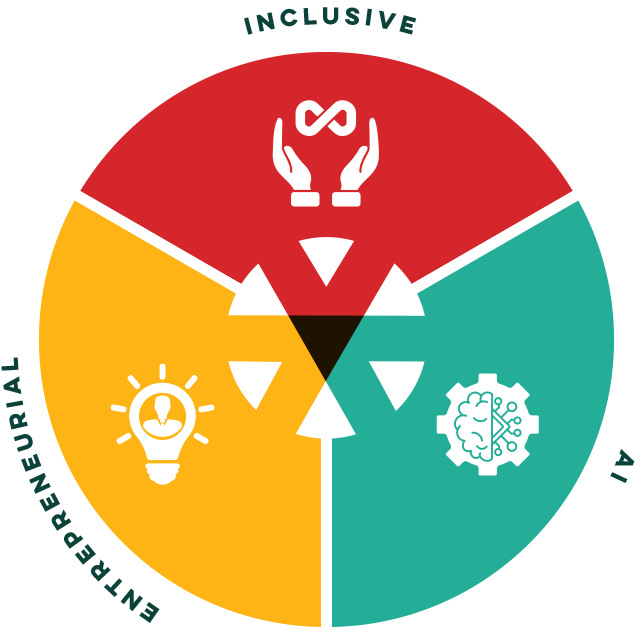
Jenny Garrett Global is a leadership development consultancy working across three pillars: Inclusive Leadership, Entrepreneurial Leadership and AI-Ready Leadership. Our AI-Ready Leadership work helps leaders create the conditions for AI to succeed, so that no one falls through the cracks.
Go further:
- Read our white papers, AI & The Two-Tier Workforce and our white paper on AI and trust.
- Order AI for Equity: Creating a More Equitable Society for All by Jenny Garrett OBE and Leah-Sunshine Garrett, published 27 October 2026 (details).
- Talk to us about AI-Ready Leadership for your organisation: enquiries@jennygarrett.global.
References
All sources accessed October 2026. Where a primary report sits behind a paywall, the linked secondary source reports its findings.
Government and public bodies
- Department for Science, Innovation and Technology (2026). Assessment of AI capabilities and the impact on the UK labour market. 28 January.
- GOV.UK (2026). Free AI training for all, as government and industry programme expands. 28 January.
- Greater London Authority (2026). London’s workforce exposure to generative artificial intelligence. April. Reported by Euronews and Inkl.
- House of Lords (2026). Artificial Intelligence: Impact on Employment. 13 April.
- International Labour Organization and NASK (2025). Generative AI and Jobs: A Refined Global Index of Occupational Exposure. Reported by UN News and The People Space. 20 May.
- Office for National Statistics (2026). Business insights and impact on the UK economy, 8 October. Reported by Quasa and Resultsense.
Research and think tanks
- Brynjolfsson, E., Chandar, B. and Chen, R. (2026). Canaries in the Coal Mine? Six Facts about the Recent Employment Effects of AI. Stanford Digital Economy Lab, August revision.
- Cranney et al. (2026). Global Evidence on Gender Gaps and Generative AI Over Time. Harvard Business School AI Institute.
- Dell’Acqua, F. et al. Navigating the Jagged Technological Frontier. Harvard Business School and BCG. Reported by AI Business.
- IPPR (2026). Overhaul worker rights to prevent AI-driven inequality. 29 May.
- Kosmyna, N. et al. (2025). Your Brain on ChatGPT: Accumulation of Cognitive Debt. MIT Media Lab. Reported by AVID Open Access.
- Mäkelä, E. and Stephany, F. Complement or substitute? How AI increases the demand for human skills. Oxford Internet Institute.
- Stephany, F. and Duszynski, J. (2026). Women Worry, Men Adopt: How Gendered Perceptions Shape the Use of Generative AI. January.
- Stanford Social Media Lab and BetterUp Labs (2025). AI workslop survey. Reported by Fast Company and UNLEASH.
- Work Foundation and Survation (2026). Entry-level hiring survey, August. Reported by Explainx and Perplexity AI Magazine.
Employers, professional bodies and industry
- CIPD. One in six employers say AI will shrink headcount. Labour Market Outlook.
- Deloitte (2026). UK CFO Survey, Q3. Reported by Bloomberg. 13 October.
- Employment Hero (2026). Graduate jobs hit a decade low.
- McKinsey (2026). AI job losses fall short of forecasts. From The State of AI in 2026, 25 August.
- PwC (2026). UK AI Jobs Barometer. June. Entry-level findings reported by Fortune and SBAM.
- PwC (2026). Global Workforce Hopes and Fears Survey. Reported by Benefits and Pensions Monitor.
- TUC. Worker consultation polling. Reported by Recruiter.
News and analysis
- British Resilience Index (2026). UK job cuts tracker. To 8 October.
- Bloomberg Economics analysis. Reported by Staffing Industry Analysts.
- Klarna customer service reversal. Entrepreneur.
- HSBC UK wealth job cuts. Reuters via The Star. 7 October.
- UK worker AI confidence and AI Skills Hub coverage: Government Technology. IPPR comment on short courses: eWeek.