
70% of companies report that AI has minimal impact on their business. 87% of AI projects never make it to production. Nearly half of organisations abandoned most of their AI initiatives in 2025. These aren’t failures of technology – they’re failures of implementation. And they follow a pattern I’ve watched play out before.
After twenty years helping organisations embed inclusive leadership, I’ve seen this story too many times. A well-intentioned initiative launches with fanfare. It gets assigned to someone as an ‘extra responsibility’. It becomes performative. Staff get frustrated. Nothing fundamentally changes. Eventually, it quietly fades away.
That was DEI for many organisations. Now I’m watching the same AI adoption mistakes unfold.
The ‘Side-of-Desk’ Trap: Why AI Implementation Fails
Here’s what the side-of-desk approach looks like in practice. Someone senior champions an initiative – whether that’s DEI or AI – because they genuinely care about it. Perhaps it gets some funding, maybe even a small team. But critically, it sits outside the organisation’s core operating rhythm. It’s not built into how decisions get made, how performance gets measured, or how budgets get allocated.
Research consistently shows this pattern with DEI programmes: when diversity and inclusion work is run as a standalone function or campaign, it struggles to shift core decisions on hiring, promotion, product design and strategy. The same AI implementation challenges are now emerging. A recent EY study found that 70% of organisations lack robust AI governance models embedded in normal risk and performance management. McKinsey reports that while 92% of companies plan to increase AI investments, only 1% consider themselves ‘mature’ – meaning AI is fully integrated into workflows and drives substantial business outcomes.
I’ve seen this play out with clients. The DEI initiative that upsets staff because it feels performative – tick-box training that changes nothing about who gets promoted or whose ideas get heard. The AI project that generates excitement but no accountability, because line leaders don’t see it as ‘their’ responsibility. When either DEI or AI relies on champions and storytelling rather than being built into metrics, incentives, and process design, it stays peripheral. And peripheral initiatives get cut when budgets tighten.
What Successful AI Transformation Actually Looks Like
The organisations getting AI adoption right treat it as an operating system change, not an add-on programme. For DEI, embedded practice means inclusive hiring systems, bias-aware performance management, and equity-informed metrics built into everyday HR and leadership routines. For AI, embedded practice means:
Clear strategic linkage: AI use cases connected directly to business strategy – not ‘AI for AI’s sake.’ If your CEO can’t articulate how AI connects to your three-year plan, you have a project, not a transformation.
Cross-functional AI governance: Data, risk, legal, HR and business owners connected across the full AI lifecycle, not just technical deployment. Only 7% of organisations have fully embedded governance frameworks – leaving 93% exposed to compliance, ethical and operational risks.
Pervasive AI capability: AI skills built across the whole organisation, alongside specialist AI teams. SHRM research shows that while organisations are enthusiastic about AI, the broader workforce doesn’t feel equipped to work with it effectively. This skills gap isn’t just a technical deficiency – it’s a strategic blind spot.
You can’t outsource AI readiness to a technology team any more than you can outsource inclusion to an HR function. Both require capability that lives in line leadership.
What Western Organisations Can Learn from the Global South
Here’s where it gets interesting. There are meaningful regional differences in how this ’embedded versus project’ thinking plays out – and organisations in the UK and US have something important to learn.
In many Western firms, DEI was set up as a visible standalone programme or department, then became politically contested or deprioritised. AI strategy is following the same trajectory: high-profile pilots and ‘digital factories’ run as separate units, with later attempts to retrofit governance and integration.
But in parts of Southeast Asia, particularly Singapore and emerging markets, AI adoption is increasingly framed as a broad productivity and workforce-transformation lever – with emphasis on redesigning work, embedding reskilling, and aligning incentives as part of national and sectoral strategies. World Economic Forum research shows that successful organisations integrate workforce planning into their AI roadmaps – yet only 46% currently do this. Southeast Asian SMEs report faster, more pervasive AI adoption driven by young, tech-forward entrepreneurs and supportive policy, rather than cautious, centralised experimentation.
The pattern is clear: Western companies more visibly ‘brand and box’ both DEI and AI, then struggle with integration. Several Global South contexts are moving more quickly to treat AI as a cross-cutting transformation lever tied to industrial policy and workforce design.
Three Lessons from DEI for Your AI Strategy
The DEI experience offers design lessons that can help you avoid common AI adoption mistakes:
1. Stop treating AI as a belief system owned by specialists. Position it as a capability that line leaders are accountable for, with clear metrics and AI governance. An EY survey found that 54% of senior leaders felt like failures as AI leaders – often because ownership was unclear or siloed in technology functions.
2. Build ‘quiet’ embedding. Integrate AI considerations into standard processes – strategy, budgeting, risk, people processes – rather than relying on one-off programmes that are politically vulnerable. Is AI discussed in your budget meetings, or only in town halls? That’s your litmus test.
3. Learn from what’s working elsewhere. Western firms may need to unlearn the habit of creating symbolic ‘programmes’ and instead borrow from more execution-focused approaches that tie AI directly to productivity, workforce strategy, and reskilling infrastructure.
The Uncomfortable Question About Your AI Readiness
So here’s the question I’d invite you to sit with: Is your AI strategy more like your old DEI programme, or more like your finance function?
If AI in your organisation has dedicated champions but no line accountability; if it generates impressive demos but doesn’t change how decisions get made; if it’s something people talk about in town halls but not in budget meetings – you may be heading for the same outcome.
The organisations that will thrive aren’t those with the most sophisticated AI pilots. They’re the ones building AI-ready capability into the fabric of how they operate – learning from what worked (and what didn’t) with DEI, and from what’s working in organisations around the world that never treated either as optional extras.
Assess Your AI Readiness:
Download the AI Integration Maturity Model – a diagnostic tool to help you identify whether you’re building embedded AI capability or running another side-of-desk initiative.
Resources
• Find out more about AI-Ready Leadership
• Listen to the AI for Equity podcast
• Read The Next Evolution of Leadership: 3 Essential Upgrades to Humanise AI Adoption
About the Author
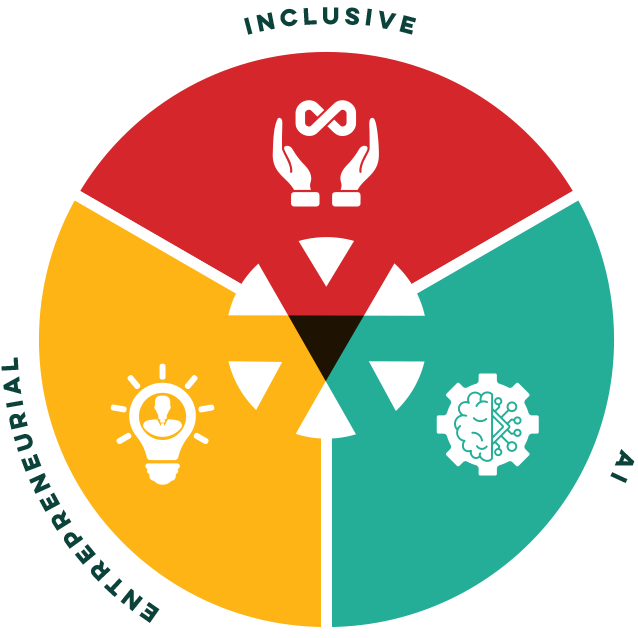
Jenny Garrett OBE is CEO and Founder of Jenny Garrett Global, a leadership development consultancy specialising in Inclusive Leadership, Entrepreneurial Leadership, and AI-Ready Leadership. She co-hosts the ‘AI for Equity’ podcast and is co-authoring a book on AI and equity with Emerald Publishing (September 2026).
Sources
Clinical Leader – The DEI Dilemma: Separate Teams or Embedded Methods
Corndel – Leading Change Together: Insights from the ABC of DEI
EY – How organisations are addressing AI risks to redesign governance
McKinsey – Superagency in the Workplace: AI Report 2025
SHRM – AI in HR 2025 Talent Trends
SHRM – AI Is Poised to Revolutionize Work — Or Wreck It
World Economic Forum – AI’s Dual Workforce Challenge
AI Journal – AI Adoption is Racing Ahead, Governance is Stumbling Behind
Channel News Asia – Singapore among Southeast Asia’s AI frontrunners
Chief AI Officer – Why Southeast Asian Small Businesses Are Adopting AI Faster