
Reflections from a parliamentary panel on AI, defence and the future of responsible power
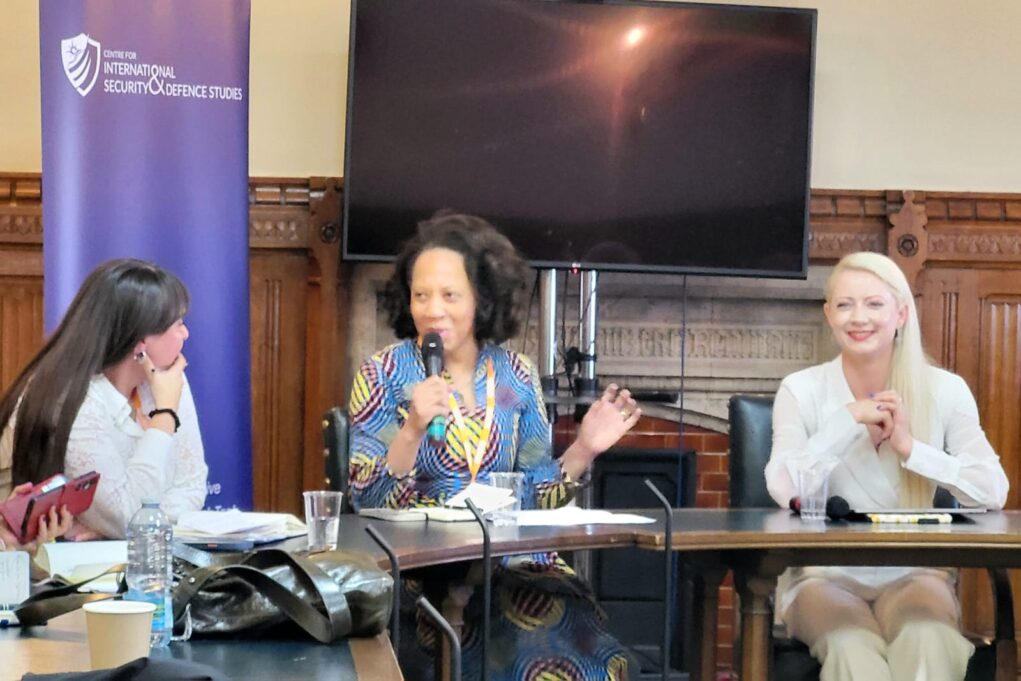
On 21 April 2026, I sat on a panel in Committee Room 20 of the Houses of Parliament, alongside Dr Allison Gardner MP, Chair of the All-Party Parliamentary Group on AI, and Dr Melanie Garson, Associate Professor at UCL. The event, AI, Defence, and the Future of Responsible Power, was hosted by the Centre for International Security and Defence Studies and chaired by Cecilia Jastrzembska, Senior Policy Advisor and co-founding member of Women in AI, UKAI.
It was, by design, an all-female panel discussing one of the most male-dominated policy conversations in the world.
The question that anchored everything for me afterwards was this: are we building AI systems that produce truth, or AI systems that produce synthetic plausibility? Because those are two very different things, and we are quietly choosing the second.
I want to share what stayed with me from the room – and why I think most leaders, in defence and elsewhere, are framing the AI question in a way that is making it harder to solve.
Are these really tensions, or are they polarities?
Cecilia structured the panel around three tensions: speed versus safety, autonomy versus accountability, and power versus inclusion. They are excellent prompts for a discussion. They are also, I would gently argue, the wrong frame for action.
Tensions imply a problem to be solved. You pick a side. You find a compromise. You move on.
Polarities are different. Polarities are interdependent pairs that have to be managed continuously, because over-investing in one side erodes the other. Breathing in versus breathing out is a polarity. Centralisation versus decentralisation is a polarity. You do not solve them. You learn to hold them.
Speed versus safety is a polarity. Defence institutions that resolve the tension by sprinting on speed end up with brittle systems that fail in operational conditions. Defence institutions that resolve the tension by maximising safety end up outpaced by adversaries who do not share that constraint. The leaders building genuinely antifragile capability are not choosing between the two. They are building the muscle to hold both at the same time.
Autonomy versus accountability is a polarity. If you push autonomy to its limit, accountability disappears into the architecture. If you push accountability to its limit, you create so much human review that the system loses its operational value. The work is in the holding.
Power versus inclusion is a polarity. Concentrated power makes decisions fast. Inclusive process makes decisions legitimate. You need both, and the cost of choosing one over the other compounds over time.
Here is the deeper point. Every AI system we build sits somewhere on a spectrum between predictable imperfection and unpredictable chaos. The work of governance is not to eliminate imperfection. It is to keep us on the predictable side of that line. Polarities are how leaders do that. Tensions are how leaders kid themselves.
What does cognitive resilience have to do with AI?
The panel surfaced a point I want to amplify. Pilots are required to log manual flying hours. The reason is straightforward: skill atrophies when you delegate it to automation, and when the automation fails, atrophied skill kills people.
We are not yet asking the same of leaders, analysts, intelligence officers, or operators working alongside AI systems. We should be.
This is not a defence-specific point. Most of us have already delegated more judgement than we realise. We outsource navigation to maps and forget how to read a city. We outsource metabolic regulation to Ozempic and forget that food is information. We outsource writing to AI and forget how an argument is built. None of these things are wrong on their own. The pattern is the problem. We are deskilling at the precise moment when AI is becoming most powerful, and we are doing it without noticing.
When humans become rubber stamps rather than critical reviewers, accountability disappears. Cecilia quoted that line from my forthcoming book during the panel, and the reason it matters here is that rubber-stamping is not a personality flaw. It is the predictable outcome of an environment where humans have stopped logging their manual hours.
Cognitive resilience is the AI-era leadership capability nobody is talking about. It belongs in every leadership development curriculum, every onboarding programme, every appraisal framework. It is not a soft skill. It is the load-bearing skill of working with AI responsibly.

What about agentic AI?
There is an elephant in this room, and it is moving fast.
The conversation about responsible AI has largely been a conversation about AI as a tool. Humans use it. Humans review it. Humans stay in the loop. The shift to agentic AI changes that. Agentic systems do not wait to be asked. They chain actions together, take sub-decisions autonomously, and produce downstream consequences that no single human authorised.
In defence, the implications are obvious and serious. In civilian organisations, they are arriving faster than the governance frameworks designed to handle them. When a system can take twelve actions in sequence to achieve a goal, who is accountable for action seven? When the chain produces an outcome no human predicted, what does liability even mean?
Agentic AI is not a future problem. It is a present-tense governance gap. The leaders who get ahead of it will be the ones who treat it as a polarity to be managed, not a tension to be resolved.
Five questions every leader should be asking about AI
The panel surfaced a number of themes that should now be on the agenda of every senior team working with AI, in defence or elsewhere. I want to translate them into questions leaders can take into their next executive meeting.
1. Are we anticipating misuse, or only optimising for use?
Most AI deployment plans are written by the people who want the system to succeed. The discipline of asking how a hostile actor, an unscrupulous user, or a future political environment might misuse the system is rarely built into the design process. It needs to be.
2. Where is the line between liability and accountability?
Liability is legal. Accountability is moral and operational. The panel was clear that liability for AI-enabled decisions should rest with those who deploy the systems, not be diffused across supply chains. But accountability is broader. Who explains the decision when it goes wrong? Who is answerable to the people affected? Liability without accountability creates legal cover. Accountability without liability creates moral exposure. Leaders need to be clear about both.
3. Have we asked whether AI is the right answer to the problem?
The question that often goes unasked is whether the problem in front of us actually requires AI. Tech companies are hiring philosophers to fix ethics after the fact, treating responsibility as a bug to be patched rather than a principle to be designed in. The right question is upstream of all of that. What is the best tool for this job, and what are we trading off when we choose AI.
4. Whose perspectives are missing from the design?
If your AI system has been designed without the people most likely to be affected by it, your blind spots are now embedded in the architecture. In defence, the panel was explicit: blind spots are vulnerabilities. NATO has recognised the weaponisation of gendered narratives and technology-facilitated abuse. A lack of inclusion in this context is a security risk. The case studies are not hypothetical. We have already seen what happens when generative AI systems are built without thinking through representation, history or context. The fixes are always more expensive than the foresight would have been.
5. What is our drift detection plan?
AI drift is the phenomenon of models behaving unpredictably as their operational context changes. It is particularly dangerous in dynamic environments where conditions evolve faster than models can adapt. Every senior team deploying AI should be able to answer: how will we know when the system is behaving outside its safe operating envelope, and what is our response when it does.
The political economy nobody wants to discuss
There is one observation from the panel that deserves to sit on its own, because it is the most uncomfortable.
Autonomous weapons systems are sometimes framed as a way to minimise risk to a country’s own armed forces. That framing is not wrong. It is also incomplete. When you remove the human cost of conflict from one side of the equation, you also remove one of the most important political constraints on the use of force. Casualties have always been a brake on escalation. What happens to that brake when the side authorising the use of force is no longer paying it?
This is not a question for the Ministry of Defence alone. It is a question for Parliament, for civil society, for the public. It belongs in democratic conversation, not just in classified briefings.
Where do we go from here?
The character of conflict is changing. The character of leadership has to change with it.
Defence is the sharpest possible test case for responsible AI, because the consequences of getting it wrong are irreversible and visible. But the principles that emerged from this panel apply far beyond defence. Every organisation deploying AI is making decisions today that will shape what is permissible tomorrow. What is permissible in design becomes probable in deployment.
We are not short of frameworks. We are short of leaders willing to hold the polarities, log their manual hours, ask the harder questions before the systems are built rather than after they fail, and build cognitive resilience into the people working alongside the technology. This is a whole-of-society problem. It will need a whole-of-society answer.
Ethical AI is not a brake on capability. It is where capability comes from.
That is the work. And it is the work that determines whether AI becomes a multiplier of human capability or a substitute for human accountability.
I know which one I want to build.
About the author
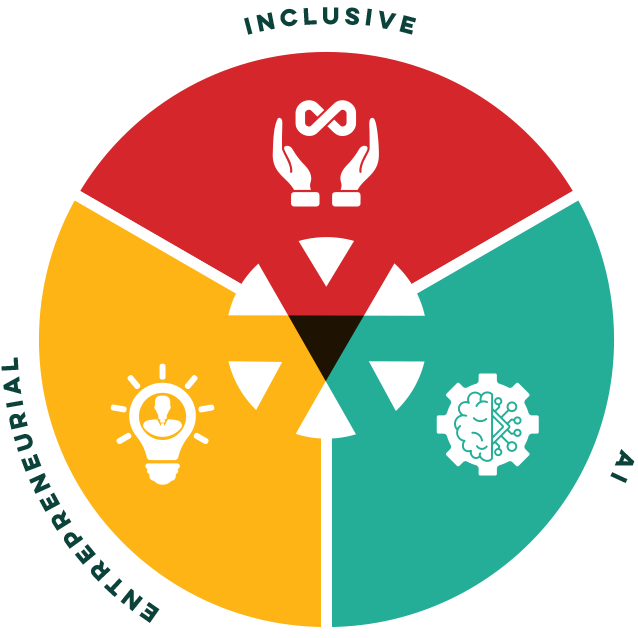
Jenny Garrett OBE is the founder and CEO of Jenny Garrett Global, a leadership development consultancy specialising in Inclusive, Entrepreneurial and AI-Ready Leadership through her Tri-Level™ methodology. She is a graduate of the MIT AI Strategy and Leadership Programme and a Freeman of the Worshipful Company of HR Professionals. Her forthcoming book, AI for Equity: Creating a More Equitable Society for All, co-authored with Leah-Sunshine Garrett, is published by Emerald in October 2026.