
I joined Erica Farmer and Christine Chiang to talk about AI strategy, on The Women Talking About Learning Podcast,. Our shared view: the organisations getting AI right are not the fastest adopters. They are the ones that challenge the bias built into their tools, adopt AI together, rethink how work actually gets done and keep human judgement in charge.
Most AI strategies I see are built through one lens: efficiency. How much time can we save? How much can we automate? Those are fair questions. But they are not the first question.
The first question is: who is this technology built for, and who is it quietly leaving out?
Whose default is AI built around?
AI risks baking inequity into our systems at a scale we have never seen, and making it invisible while it does so. Much of the data these tools learn from centres a narrow default: often white, often American, often male. Unless leaders push back, the answers, advice and interfaces we rely on are calibrated for that default and miscalibrated for everyone else.
That is not a technical problem. It is a leadership one. Someone in the room has to ask, “who does this answer not work for?”
Why does siloed AI adoption fail?
Because it multiplies the gaps instead of closing them. Erica made a point I strongly agree with: organisations need a shared baseline and a shared language for AI. When teams experiment in isolation, some race ahead and others never start. A unified approach means reskilling lifts the whole workforce together, not just the people who were already confident.
Is AI strategy really about the tools?
No. Christine brought the view from behind the scenes, where the real work is operational. Moving legacy content and workflows into structured, multi-channel environments is complex, and it is where strategies succeed or quietly fail. The strategy is not the tool you buy. It is how you restructure delivery without compromising quality or stability.
Speed is easy now. Work you can stand behind is harder.
Who gets reskilled, and who gets left behind?
Too often, upskilling goes to people who are already senior, already confident, already at a desk. Deskless and lower-paid workers, whose roles are most likely to change, are the least likely to be offered support. I explored this in our white paper, AI and the Two-Tier Workforce. Proactive reskilling is not charity. It is how you keep the talent and knowledge you already have.
How do you keep AI aligned with your values?
Treat AI as augmentation, not replacement. Keep humans in the loop where judgement, ethics and relationships matter. And use your values as the test: if a use of AI would not survive an honest conversation with your people, it should not survive your strategy.
So, who is coming with you?
The organisations that thrive with AI will not be the ones that move first. They will be the ones that move together, and notice who the technology was never designed for. So before your next AI investment, ask: who is coming with us, and who have we forgotten?
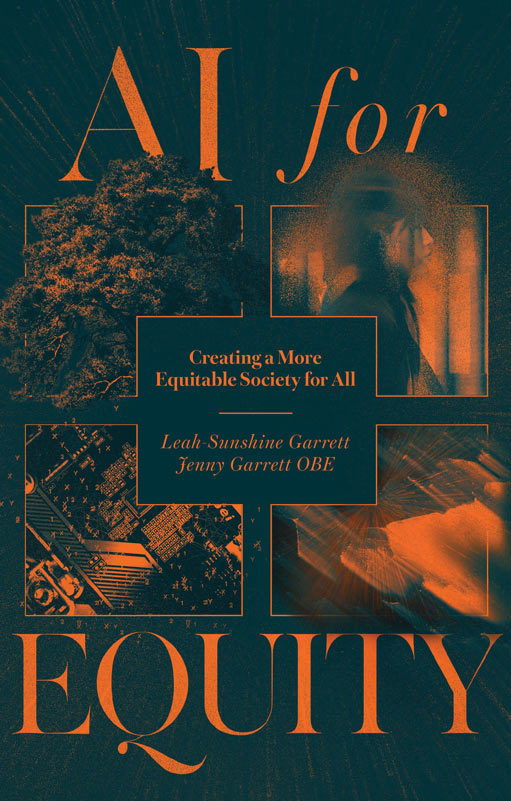
This is the heart of my book, AI for Equity, published by Emerald on 27 October 2026.
Frequently asked questions
Is AI biased?
AI tools learn from data that often reflects a narrow default user, so their outputs can be miscalibrated for people outside it. Leaders need to test and challenge outputs rather than assume neutrality.
What is an equitable AI strategy?
One that deliberately considers who benefits and who could be disadvantaged, and builds in shared access, training and human oversight across the whole workforce.
Why do organisations need a shared AI baseline?
A common baseline and language stop teams adopting AI in silos, reduce duplication and make sure upskilling reaches everyone.
How can organisations avoid a two-tier workforce with AI?
By extending reskilling and AI access to deskless and lower-paid roles, and planning for role change before it happens.